

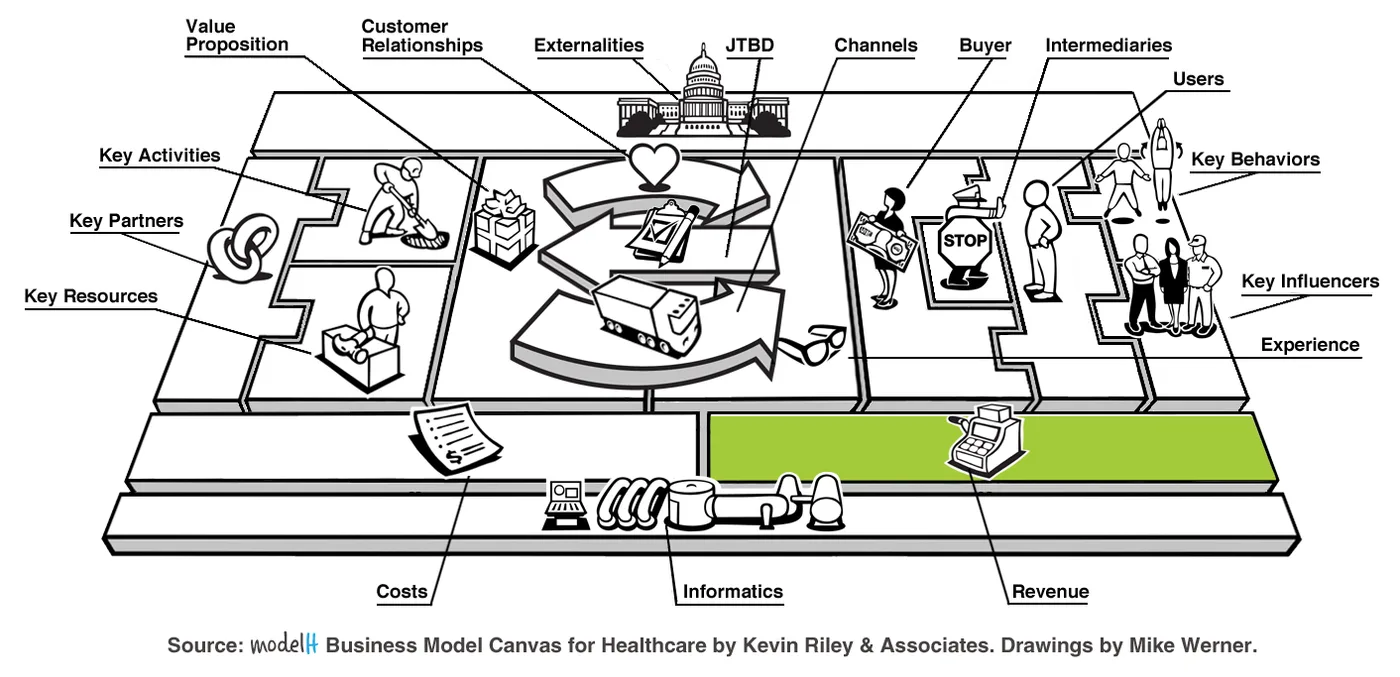
modelH Business Model Canvas: Revenue
Revenue is the way a company makes money from its customers. In healthcare, the party who benefits, the party who pays, and the party who decides are often different. Separate those before you set a price. There are two kinds of innovation, as Stefan Michel argued in HBR: one in value creation and one in value capture. Most companies focus only on the first.
Questions for the Revenue Block
- How will your business make money?
- For what value are customers willing to pay?
- What do they pay now, and what is your pricing strategy?
- How do they pay now, and how would they prefer to pay?
- What is your TAM, SAM, and target market?
- What is your revenue cycle, and how will you manage it?
Revenue Models
The canvas lists these: traditional sale, value-add, freemium, affiliate, subscription, virtual goods, and advertising. Paul Sloane's Nine Ways to Innovate with Monetisation adds more ideas: turn a product into a service, like Rolls-Royce's pay-per-engine-hour TotalCare; demand or auction pricing; razor and blades; bundling and unbundling; pay what you can; getting someone else to pay; and changing what you charge for, as Netflix did to Blockbuster.
Most of these came straight from outside healthcare, and they read differently now.
The Five AI Revenue Models
1. Per seat. Familiar, but dangerous if AI reduces the number of people doing the work. You are betting against your own product.
2. Per usage. Matches your compute cost. It can scare Buyers, who dislike unpredictable bills, and it gives you no share of value.
3. Per job. You charge per completed prior authorization, coded chart, or resolved call. You are selling labor, so you compete for a much larger budget. You also own the quality.
4. Per outcome or at risk. You get paid when the denial is overturned, the gap closes, or cost falls. CMS's ACCESS model, which began in July 2026, ties full payment for technology-supported chronic care to measurable outcomes. Observers expect participants to lean on automation and AI. This fits our definition of value. It requires measurement you and the customer both trust, and enough capital to wait.
5. Bundled or free. Platforms give it away to protect something else. athenahealth said its ambient tool would come to customers at no additional cost. If a large platform bundles your category, your pricing conversation is over.
My view: move toward 3 and 4 where you can prove results. Be clear-eyed about your cash flow.
Who Pays for AI in Healthcare?
This is the question that kills good ideas. There is often no billing code for AI, so most vendors depend on budgets. That tends to mean labor savings, Revenue uplift, or risk contracts. Life gets harder if your benefit lands on someone other than your Buyer.
Also watch for revenue that depends on an arms race. If your Value Proposition is that your AI beats the other side's AI, a rule change or a shared standard may wipe it out. Build revenue on value that would survive if everyone played fair.
Revenue Cycle Is Being Rebuilt
The revenue cycle itself is one of the largest AI categories, with coding and billing automation at about $450 million in 2025 spending, according to Menlo Ventures. Payers are also adopting it. Expect faster payment in some areas and sharper disputes in others. Include this in your cash flow assumptions.
Life Sciences Revenue
AI-native companies generally choose among selling software, selling services, partnering, or owning assets. Each has a very different risk and return. 2025 partnerships totaled $43.4 billion in potential value, but cash arrives through upfronts and milestones. That same report says trackers showed no AI-discovered drug with full FDA approval as of mid-2026, though Takeda's zasocitinib, designed with computational help, was under priority review with action expected in early 2027. The asset-owning model still has to pass through the same regulators and biology as everyone else.
New Questions for 2026
- Does our pricing punish us when our AI works?
- Which budget pays: software, labor, or risk?
- Can we prove the outcome well enough to get paid for it?
- What happens to our Revenue if a platform gives this away?
- Would this Revenue survive the end of the arms race?
What is Next?
Next, we look at Externalities.
to your health,
Kevin