

Business model canvas for healthcare and life sciences
Design the business model behind better care.
modelH gives your team 17 building blocks for what a classic canvas misses in healthcare and life sciences: users who aren't the buyers, the jobs patients need done, and the outcome achieved per dollar spent.
- Free
- No account needed
- AI on your own Claude or OpenAI key
- Open canvas, CC BY-SA 3.0
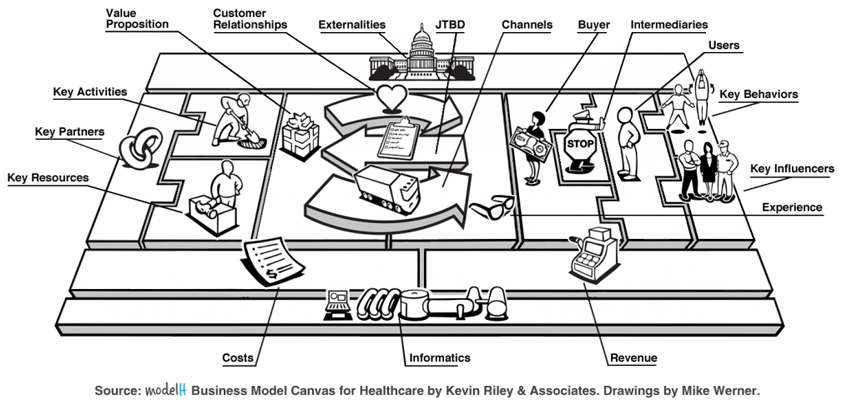
The modelH canvas
Seventeen building blocks, four questions.
Expanding on Osterwalder's nine blocks with Porter's shared value and Christensen's jobs-to-be-done, modelH judges a model on whether it can deliver value and on the health outcome it achieves per dollar. Work through the blocks in order.
CustomersThe Who
Who is served, who pays, and what they are trying to get done.
- 1Users
- 2Buyers
- 3Intermediaries
- 4Jobs-to-be-Done
- 6Key Behaviors
- 7Key Influencers
ProductsThe What
What is offered, and how it reaches and stays with customers.
- 5Value Proposition
- 8Channels
- 9Customer Relationships
- 10Experience
OperationsThe How
What it takes to deliver the value, and the data that proves it.
- 11Key Activities
- 12Key Resources
- 13Key Partners
- 16Informatics
FinancialsThe How Much
What it costs, how it earns, and the outside forces on both.
- 14Costs
- 15Revenue
- 17Externalities
How teams use it
From sticky notes to a report you can stand behind.
Start rough on the canvas, answer the guiding questions, then switch to the report view to share a written model with an executive, an investor or a partner.
A canvas your team works on together
Sticky notes in eight colors, dragged between blocks. Changes save as you go and appear for teammates within seconds.
A report you can hand over
The same notes become a written report: The Who, The What, The How and The How Much, with guiding questions for every block.
AI that reads your sources
Add your website, documents or web research. Your own Claude or OpenAI key drafts the canvas, suggests notes and reviews the model.
Share it, keep every version
An edit link for the team, a read-only link for everyone else, embed code for your site, and a history you can restore from.
Getting started
Four steps to a first draft.
- Create a canvas
Choose the modelH canvas or the classic Business Model Canvas and give it a name.
- Add what you know
Sticky notes on the canvas, answers to the guiding questions, your website and documents as sources.
- Draft and review with AI
Use your own Claude or OpenAI key to fill gaps, test assumptions and write the report.
- Share the report
Send the edit link to your team and the read-only link to everyone else.
Learn
modelH in the age of AI.
A block-by-block series on the modelH canvas, revisited for 2026: what AI changes in every block, and a new eighteenth block, AI Proof.
New to modelH? Start with “Is your healthcare company run by a business model or a busyness model?”
Read the blog