

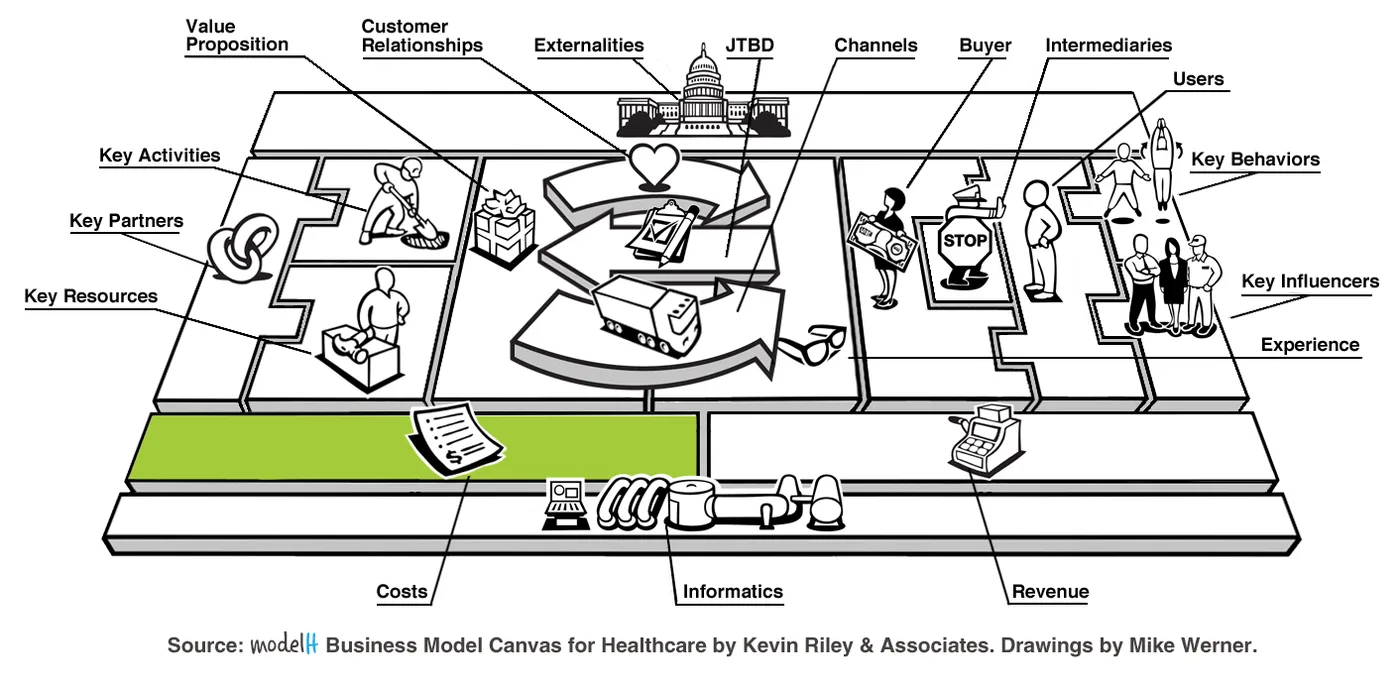
modelH Business Model Canvas: Costs
Costs are the most important financial drivers of a business model. There is a case that Costs are the most important of all the healthcare building blocks, because the U.S. spends far more of its GDP on healthcare than peer countries do, and it is hard to tell the good costs from the bad.
It comes back to Porter's definition of value: outcomes per dollar. Your model should reduce the aggregate cost of care, not just move it around.
Questions for the Costs Block
- What are the most important fixed Costs?
- What are the most important variable Costs?
- What drives them, and which are controllable?
- Which can be reduced through economies of scale or scope?
- Which Channels and Customer Relationships are most expensive?
- Which Key Behaviors, Key Resources, and Key Activities are most expensive?
Know Your Numbers
You have most of what you need in your P&L: Revenue, Cost of Goods Sold (in care delivery, your actual medical cost), Gross Margin, Operating Costs, Operating Income, and Net Income. Your base includes salaries, professional fees, rent, utilities, depreciation, interest, and maintenance. Then add what is specific to your industry, like claims incurred but not reported for insurers.
Build a budget, track actuals, and repeat for as long as you run the business. Also compare your costs with the cost of doing nothing, for the User, Buyer, and system. If your model is cheaper only for you, question its value.
Having started several healthcare companies, some successful and some not, my advice is simple. Bring in a qualified financial expert who knows your business, and do it from the start.
How AI Changes the Cost Structure
Labor shifts. Some cost moves from salaries to software. Yet adopting AI rarely eliminates the whole job. It often removes pieces of many jobs, so the savings do not show up unless you redesign the work.
Fixed becomes variable. Traditional software had near-zero marginal cost. AI does not. Each query, call, and agent run costs something, and heavy users can eat your margin. Know your cost per completed job. Prices per unit of AI have been falling, but usage tends to grow faster, and more complex agents use far more computing.
New costs arrive. Count evaluation, monitoring, review, governance, security, integration, data preparation, retraining, and liability. The demo cost nothing. Production is not free.
The cost of quality. When AI is wrong in healthcare, you pay to fix it. Include the cost of errors and escalation.
Pilot sprawl. Many inexpensive pilots add up to a large expensive portfolio with no outcomes. Put each one on the canvas, or end it.
Beware the Systemic Cost Trap
This is the part I most want healthcare leaders to think about. Your AI might lower your own costs and raise total costs.
- If scribes improve documentation, coding intensity may rise, and payers will respond. A study showed adopters generated 1.81 more RVUs per physician without more denials. That helps those physicians. Who pays for it?
- If providers automate appeals and payers automate reviews, both spend money to fight each other.
- If AI finds more findings, you may get more follow-up, some valuable and some not.
Early findings on administrative AI are real, but the savings can leak. Ask who actually keeps them. Under fee-for-service, productivity may simply raise volume. Under risk, savings can fund care. This is one reason I think value-based models and AI are natural partners.
Life Sciences Costs
Drug development's largest costs live in clinical trials. AI can help with target selection, patient recruitment, and trial design. Still, as one review finds, trial durations have not consistently shortened. The real prize may be fewer failures rather than speed. Avoiding one late-stage failure is worth far more than saving a few weeks of chemistry.
New Questions for 2026
- What is our cost per completed job, including human review?
- How does our margin change if our heaviest users double usage?
- Which new AI costs have we left out of the model?
- Do our savings lower total cost of care, or move it elsewhere?
- Who keeps the savings?
What is Next?
Next, we look at the other side of the ledger: Revenue.
to your health,
Kevin