

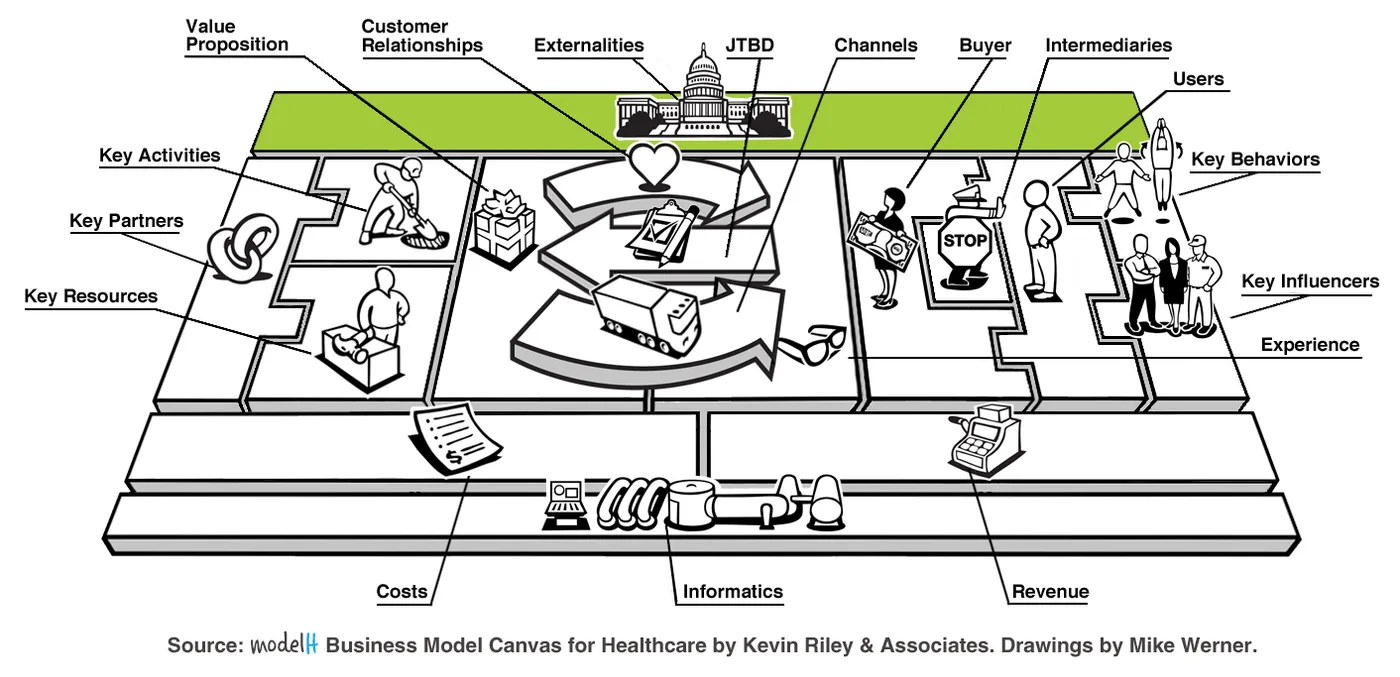
modelH Business Model Canvas: Externalities
Externalities are the external forces and regulations imposed on a business model. This was the most debated block in our 2013 forum. Strict canvas purists said the external environment belongs in strategy, not in a business model. They had a point, and Osterwalder himself argued competition is not part of your business model. Others in the community argued we were over-engineering the thing.
I kept it, using two tests. Does the block affect the business model? Is it needed to explain how the model works? In healthcare, an FDA decision or a CMS rule can make or break a business. Thirteen years later, I am more convinced.
Questions for the Externalities Block
- What Externalities put constraints on your business model?
- How do they restrict your Buyers and Users?
- How do they affect your User's Key Behaviors?
- How do they affect your Key Influencers?
- How do they drive Costs?
- How can they be turned into Revenue streams?
The AI Landscape as of Late 2026
This will age quickly, so treat it as a snapshot and check for updates. None of this is legal advice.
FDA. The agency reports over 1,600 authorized AI-enabled medical devices as of September 2026. Its guidance list shows final clinical decision support and general wellness guidance from January 2026, final guidance on Predetermined Change Control Plans from August 2025, and lifecycle guidance for AI-enabled devices still in draft. Whether software is a device depends on what it does and whether a clinician can independently review the basis for it.
CMS. According to Holland & Knight, CMS is shaping adoption largely through payment models and pilots. WISeR began January 1, 2026 in six states, using AI and machine learning to support medical necessity reviews, with licensed clinicians making non-payment recommendations. It remains politically contested. ACCESS began in July 2026. The prior authorization rule requires new APIs from impacted payers by January 1, 2027.
States. Rules vary by state. Texas's HB 149 took effect January 1, 2026, and requires providers to tell patients when AI is used in diagnosis or treatment. A December 2025 executive order on national AI policy adds uncertainty about how state and federal rules will fit together.
Other forces. Add HIPAA and consumer tools that fall outside it, liability law that courts are still working out, international regimes like the EU AI Act, professional licensing, copyright, and chip and export rules that affect your suppliers.
Beyond Regulation
The definition is external forces, not only regulations. Three matter a great deal right now.
Public trust. A single high-profile harm can reset your whole category. A Nature Medicine study finding that ChatGPT Health under-triaged about half of simulated emergencies is the kind of result that shapes what regulators and the public will accept.
The pace of the models. Model capability is now an external force. A new release can make your roadmap obsolete or finally make your idea possible.
Labor and professional reaction. Unions, medical societies, and state boards all have a say.
Turning Externalities into Advantage
My favorite question on this block is the last: how can they be turned into Revenue?
- Regulatory clearance can be a moat when competitors have not done the work.
- Real-world evidence requirements favor those who already collect it.
- Compliance can be a product, as with audit trails and governance tools.
- New mandates, like prior authorization APIs, create buyers with deadlines.
In AI, the slow, unglamorous work of evidence and compliance may be one of the few things that cannot be copied in a weekend. And regulation cuts both ways: a rule that protects you today can be reversed tomorrow. So do not build your whole model on one rule.
New Questions for 2026
- Is any part of our product a regulated device, and how do we know?
- Which rules do we depend on, and what if they change?
- Which states and countries are we operating in, and do their rules conflict?
- What happens to our model if our category has a public failure?
- What would a model improvement in the next year do to us?
- Can our compliance work become an advantage?
What is Next?
We wrap up the How Much.
to your health,
Kevin