

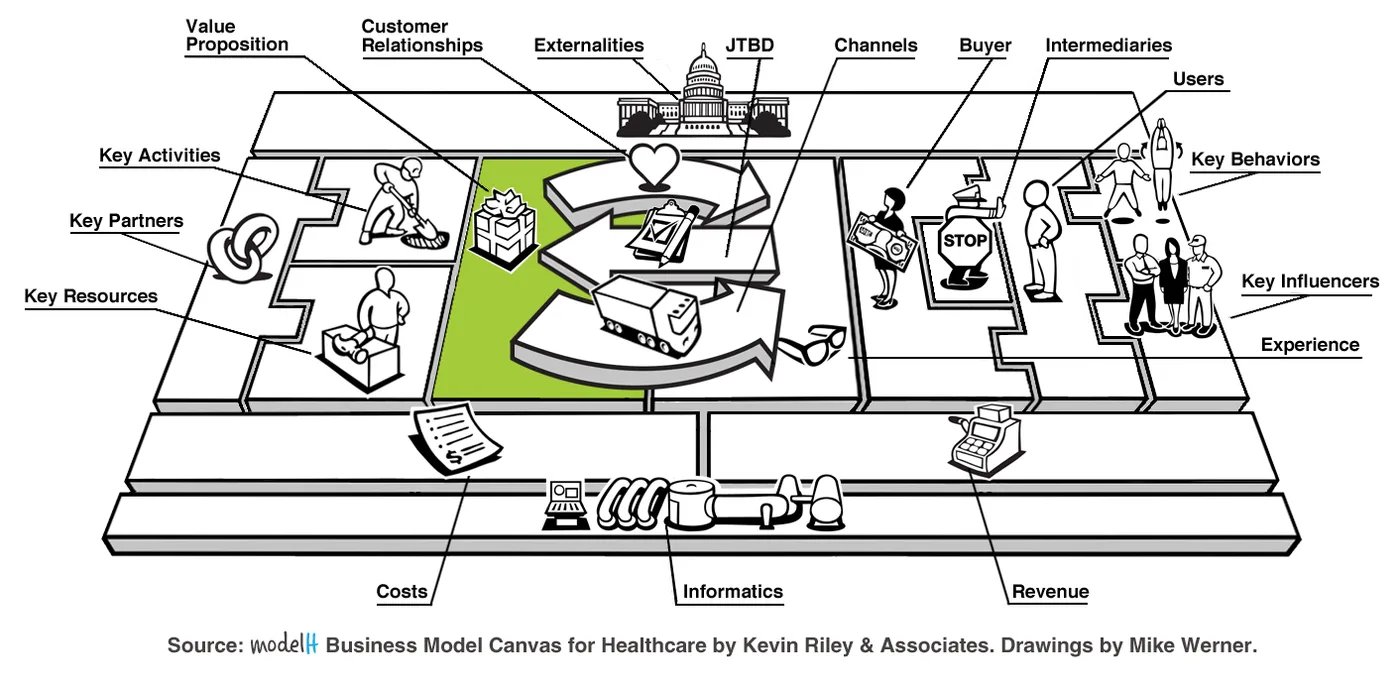
modelH Business Model Canvas: Value Proposition
"When we buy a product, we essentially 'hire' something to get a job done. If it does the job well, when we are confronted with the same job, we hire that same product again." — Clayton M. Christensen
If the JTBD defines what utility a User wants, the Value Proposition (VP) describes the shared value among the key healthcare stakeholders. Your VP is your promise. Product-Market Fit (PMF) is the proof you delivered it. You know you have a great VP when Buyers acknowledge your unique benefits. You know you have PMF when they pay for them.
Look for four attributes.
- Relevancy: your product solves a User's JTBD.
- Alignment: its features and benefits match your Buyer's preferences.
- Demand: there is a measurable need in the market.
- Viability: it generates enough Revenue to sustain the business.
AI Makes PMF Perishable
In 2024, I called PMF a validation that you are on the right track. It still is, but it can now expire. A workflow you automated last year may be a free feature next year. Rate PMF on two lines: does it fit today, and will it fit after the next model release? Scribes are the example. They found real demand and adoption, then EHR vendors moved in with built-in tools.
Your Statement of Value
Start with a sentence worthy of an elevator pitch.
My company, [name], offers [a defined offering] to help [a defined audience] [solve a problem] with [secret sauce].
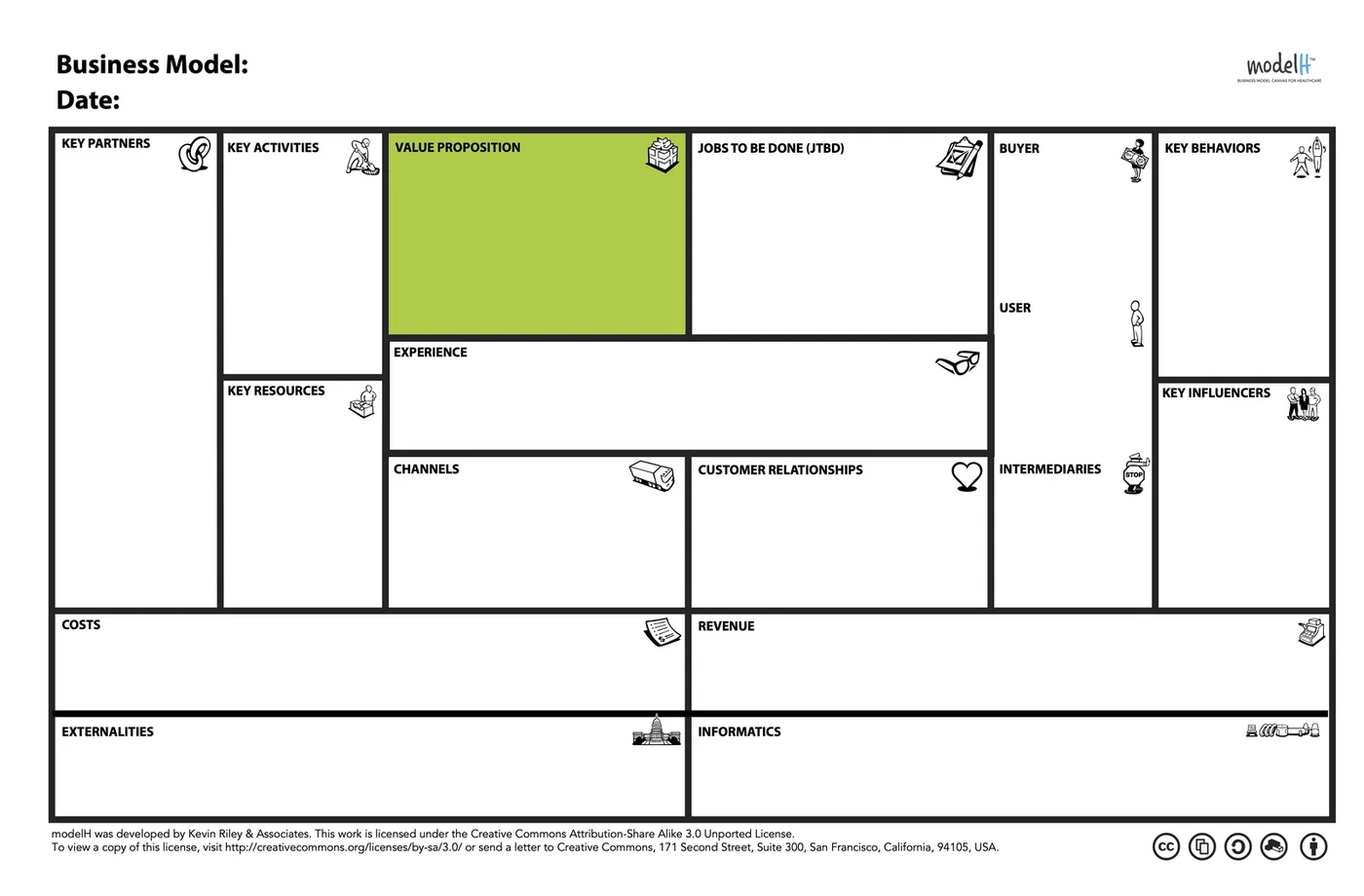
modelH Business Model Placemat: Value Proposition
Iterate as your Customer Intimacy grows. For "secret sauce," do not write "AI." Everyone will have it.
Questions for the Value Proposition Block
Osterwalder asks three.
- What value do we deliver?
- Which customer problem do we solve?
- What bundles of products and services do we offer each Customer Segment?
modelH adds these for healthcare.
- What compels a purchase decision by the Buyer?
- In what aspects of the User's life do you deliver value?
- Which jobs, pains, and gains must be addressed?
- How much time does it take to deliver?
- What social value is met while delivering it?
- What bundles are offered?
- How can it be personalized to Customer Segment needs?
- What Intermediaries derive value from it?
- How does the model gain insights from customer interactions?
- What Key Behaviors, Experiences, and Key Influencers are required to realize it?
The modelH Value Proposition Canvas
The canvas expands Osterwalder's original into two halves.
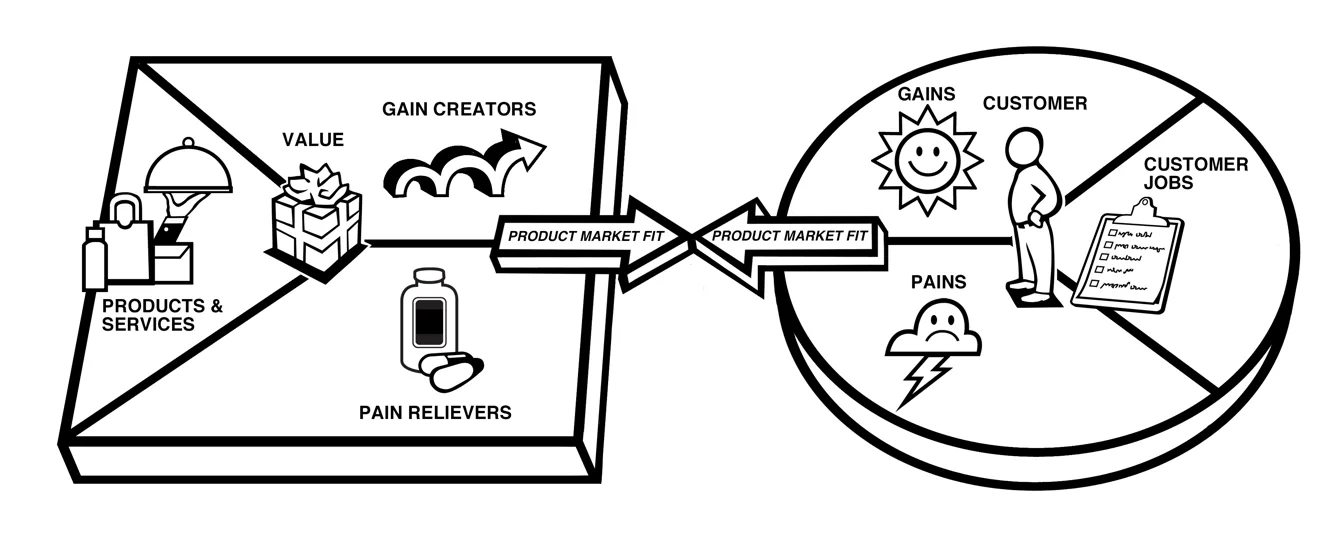
modelH: Value Proposition Canvas
Customer Segment (Right Side)
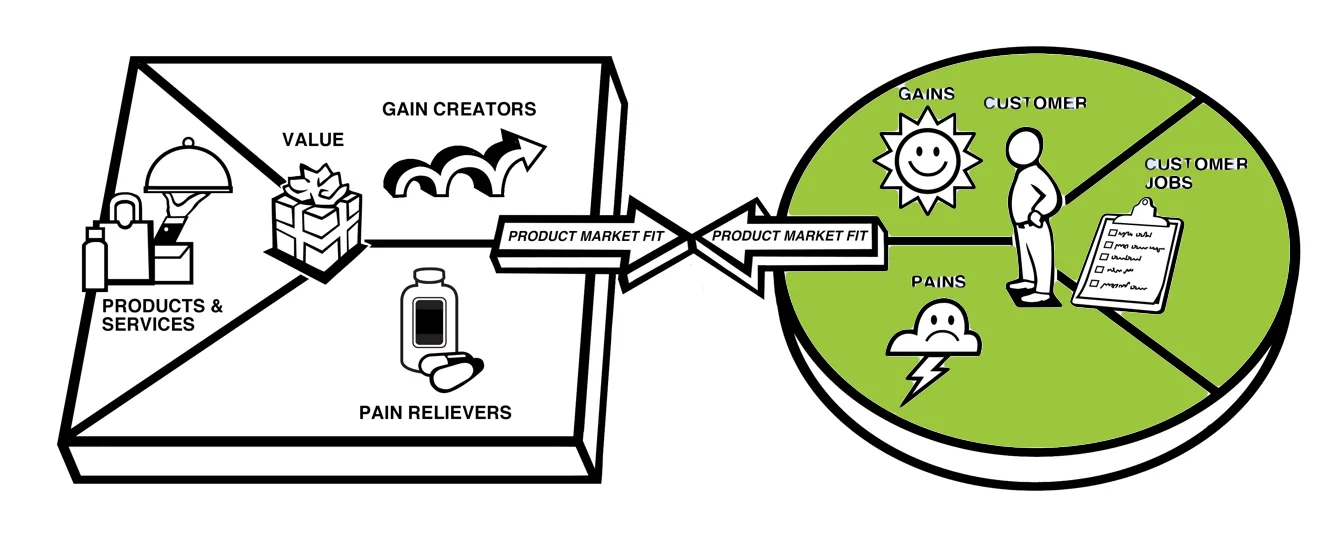
modelH: Value Proposition Canvas, Customer Segment
- Customer Jobs: what they are trying to accomplish.
- Pains and Gains: what they want to avoid and to achieve.
- Approach: how they solve it now.
- Value: what creates value when they solve it.
- Benchmark: what they compare it to.
- Criteria: how they judge effort and experience.
- Barriers: what prevents a different approach.
Value Proposition (Left Side)
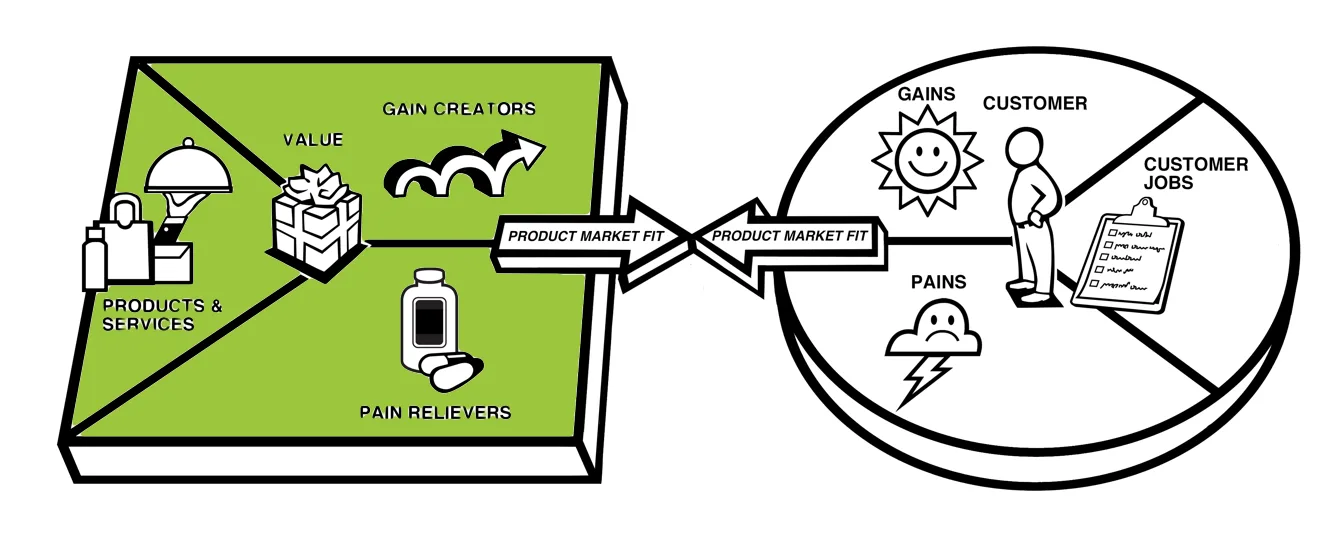
modelH: Value Proposition Canvas, Value Proposition
- Products and Services: the bundle you offer.
- Value Proposal: the value created, tied to a specific JTBD.
- Gain Creators and Pain Relievers: how you make them happy and remove problems.
Start on the right. In 2026, update two boxes. Under Approach, include AI, because "I asked a chatbot" is now how many people start. Under Barriers, add trust, liability, and governance. Those are often what stops an AI product even when the demo is great.
You can have AI draft a first pass from your interviews. It will find patterns quickly. Then test it with customers.
Classifying Products and Services
Healthcare products can be sliced four ways.
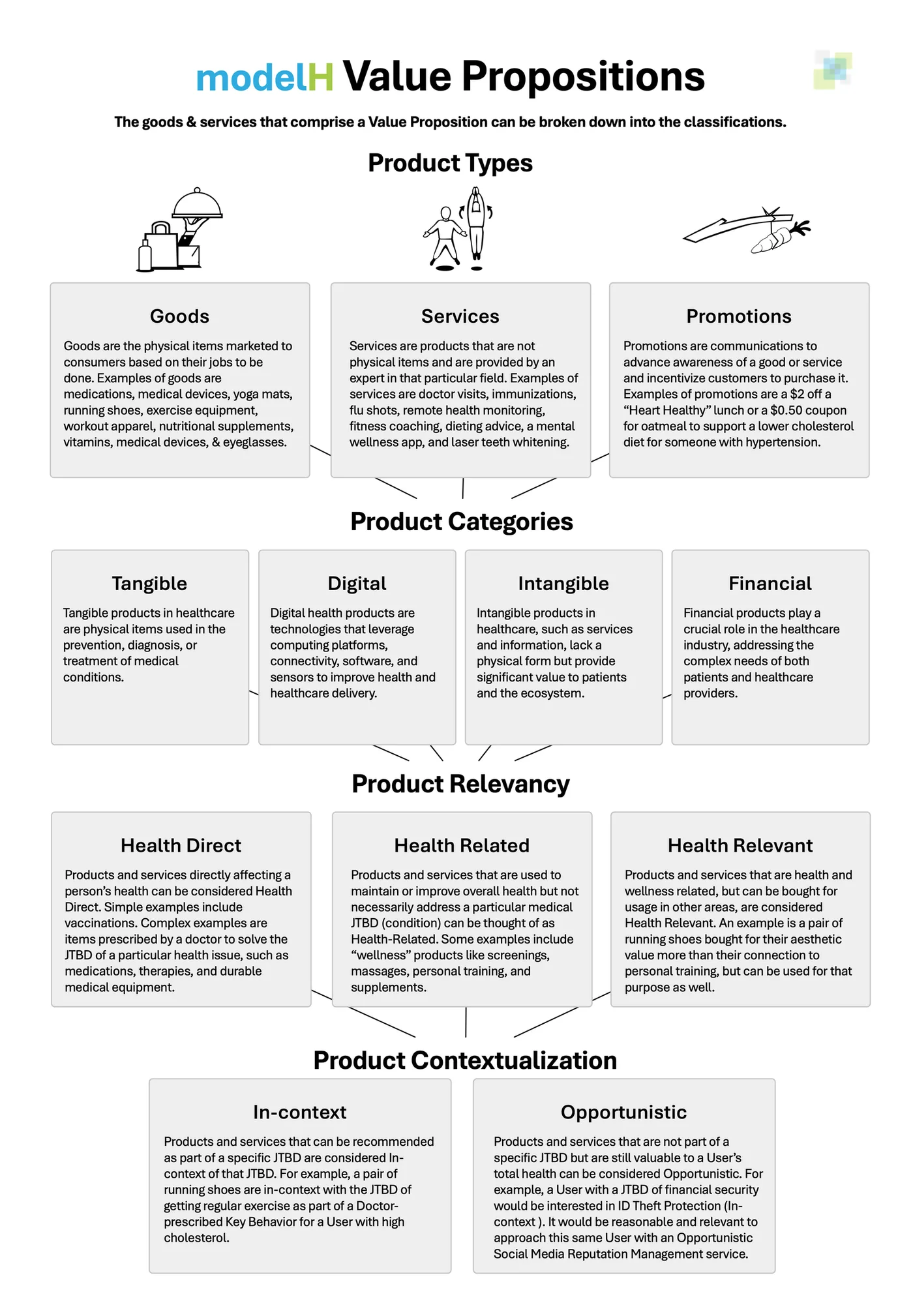
- Type: goods (medications, devices, running shoes), services (visits, coaching, remote monitoring), and promotions (a coupon relevant to a person's JTBD).
- Category: tangible (devices, drugs, supplies), digital (apps, wearables, telehealth, EHRs, analytics), intangible (care, information), and financial (HSAs, plans, financing, revenue cycle services).
- Relevance: Health Direct (treats a specific issue), Health Related (maintains health, like screenings), and Health Relevant (not bought mainly for health but usable for it, like running shoes bought for looks).
- Context: In-Context (part of a specific JTBD) and Opportunistic (valuable to the person but outside that JTBD).
Here is what those slices look like in practice.
Goods, Services, and Promotions
- Goods: medications, medical devices and monitors, yoga mats, running shoes, exercise equipment, supplements, vitamins, and eyeglasses.
- Services: doctor visits, immunizations, remote health monitoring, fitness coaching, dieting advice, a mental wellness app, and laser teeth whitening.
- Promotions: $2 off a "Heart Healthy" lunch at Chili's, or a $0.50 coupon for Quaker Oatmeal to support a lower-cholesterol diet.
Tangible Products
- Medical devices and equipment: X-ray machines and MRI scanners, surgical instruments, pacemakers and artificial joints, blood pressure monitors and glucose meters, nebulizers, and wheelchairs.
- Pharmaceuticals: prescription drugs, over-the-counter drugs, and vaccines.
- Consumables: wound care products, contact lenses, hearing aids, gloves, masks, and dietary supplements.
Digital Products
- Patient-centric: wearables, mobile health apps, telehealth, health information portals, and digital therapeutics.
- Provider-centric: EHRs, clinical decision support, remote patient monitoring software, practice management software, and health information exchanges.
- Administrative and operational: claims processing, analytics, supply chain management, and revenue cycle management.
- Other: health-focused social networks, AI diagnostic tools, and VR or AR for training, education, and pain management.
Intangible Products
- Services: consultations, nursing care, therapy, diagnostic services, and surgery.
- Information: health records, research data, health education, and health insurance plans.
Many products combine tangible and intangible elements, but the core value often lies in the service or information.
Financial Products
- For patients: healthcare loans, HSAs, FSAs, health insurance plans, and patient financing plans.
- For providers: revenue cycle management, healthcare financing, insurance reimbursement, and government grants.
- Other: medical crowdfunding, health insurance exchanges, and Medicare and Medicaid.
Context in Practice
Running shoes are In-Context for the JTBD of regular exercise, as a doctor-prescribed Key Behavior for someone with high cholesterol. For a User with a JTBD of financial security, ID theft protection is In-Context, while social media reputation management is Opportunistic.
AI adds one more slice, which I call Delivery.
- Tool: AI helps a person do the work. You sell software.
- Copilot: AI and a person share the work inside a workflow.
- Agent: AI completes defined work under supervision. You are effectively selling labor.
- Accountable service: you deliver the result and carry responsibility, using AI behind the scenes.
These have very different economics, liabilities, and regulation. Pick one on purpose. Note also that a recommendation to a clinician may be a medical device depending on how it is built and used. FDA issued final clinical decision support guidance in January 2026, so check before you ship.
New Questions for 2026
- Will this Value Proposition still be worth paying for after the next model release?
- Is the customer's current Approach already AI-based?
- Are we selling a tool, a copilot, an agent, or an accountable service?
- Does the product's function make it a regulated device?
What is Next?
Next, we apply Minimum Viable Product thinking, which AI has made both easier and more dangerous.
to your health,
Kevin