

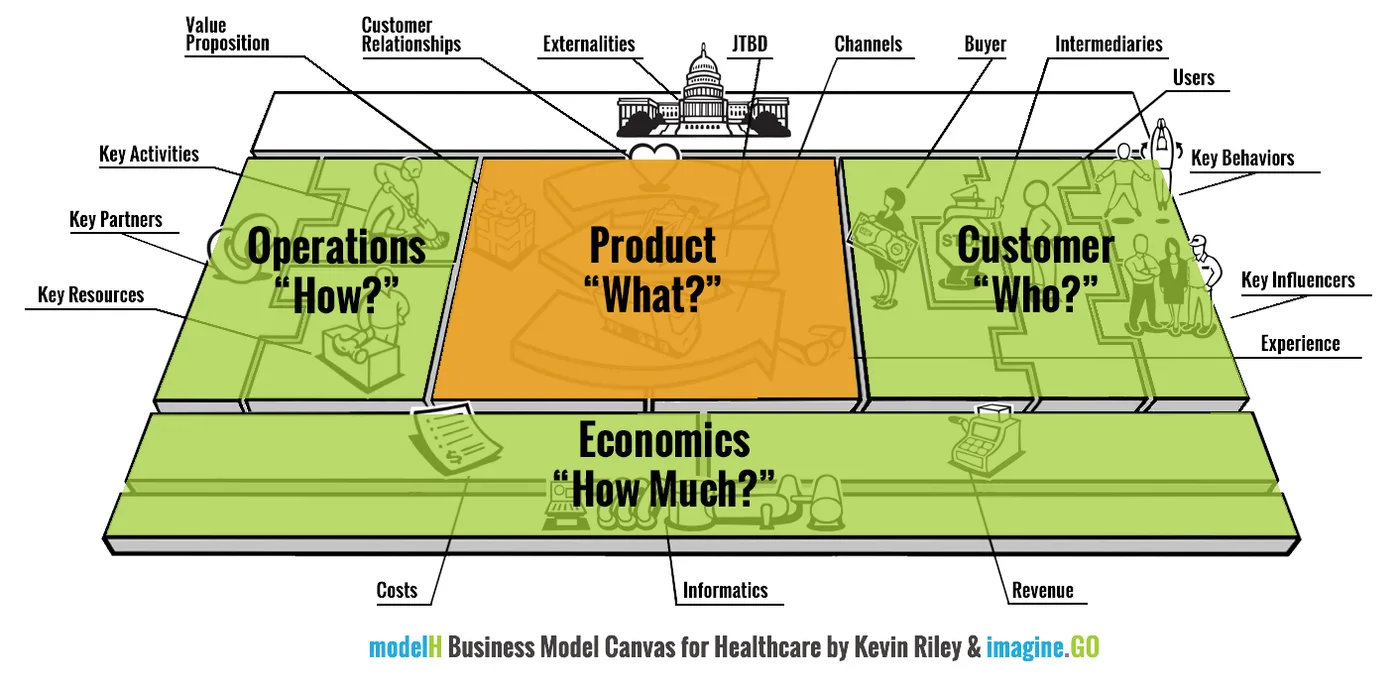
modelH Business Model Canvas: The What
"Health is the greatest of human blessings." — Hippocrates
The modelH premise can be simplified: if you know your customers, you can get them what they want and need, and make them feel delighted and appreciated in the process. You win. We covered how to know them. Now we turn to the What.
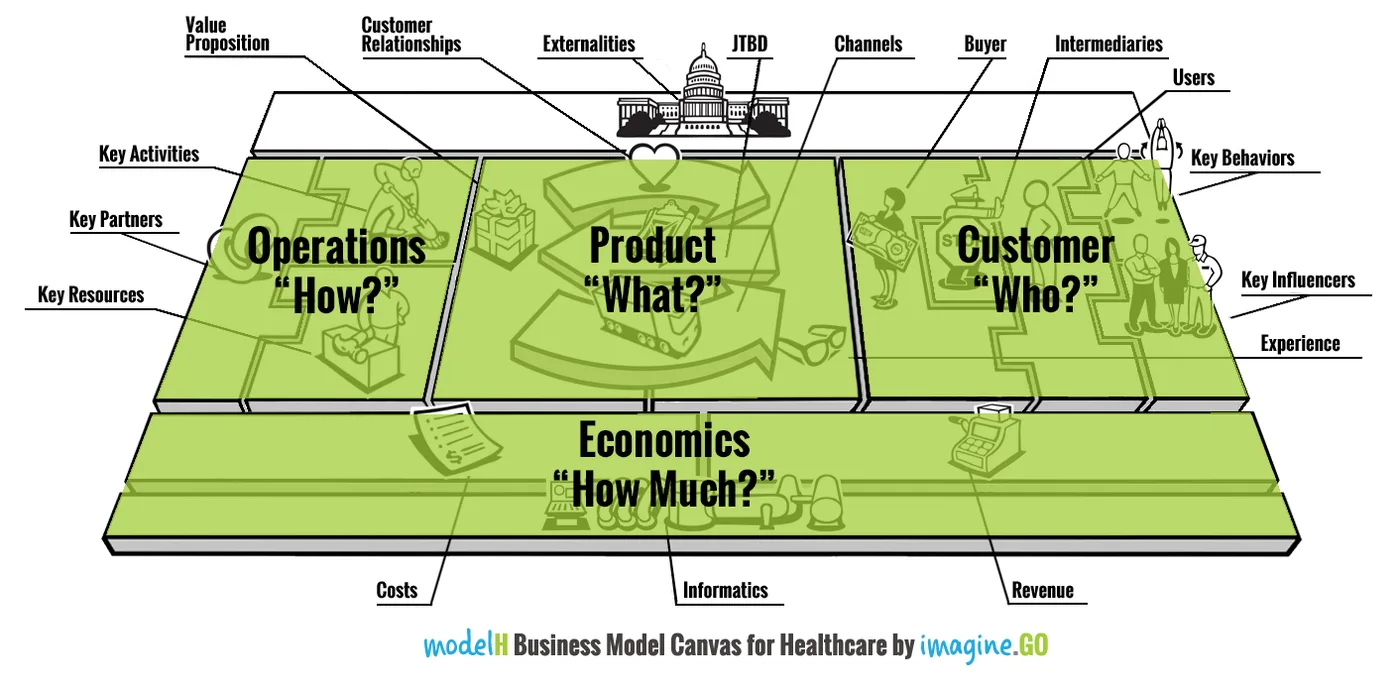
modelH Business Model Canvas: Who, What, How, and How Much
What is a Value Proposition?
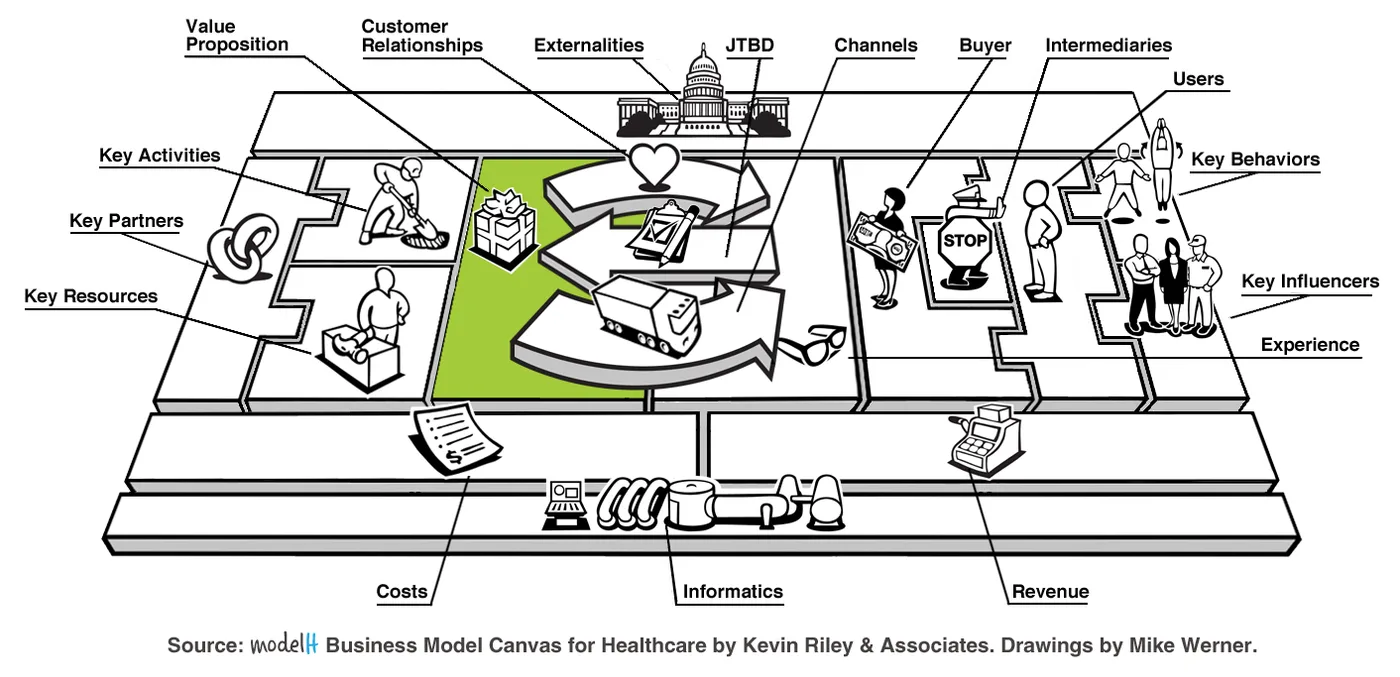
modelH Business Model Canvas: Value Proposition
I define it as a promise of value to be delivered and a customer's belief that it will be experienced. Osterwalder describes it as the collection of products and services that meets customer needs, and his Value Proposition Canvas is a practical tool for mapping them. Combine the JTBD with a Value Proposition and you get Product-Market Fit.
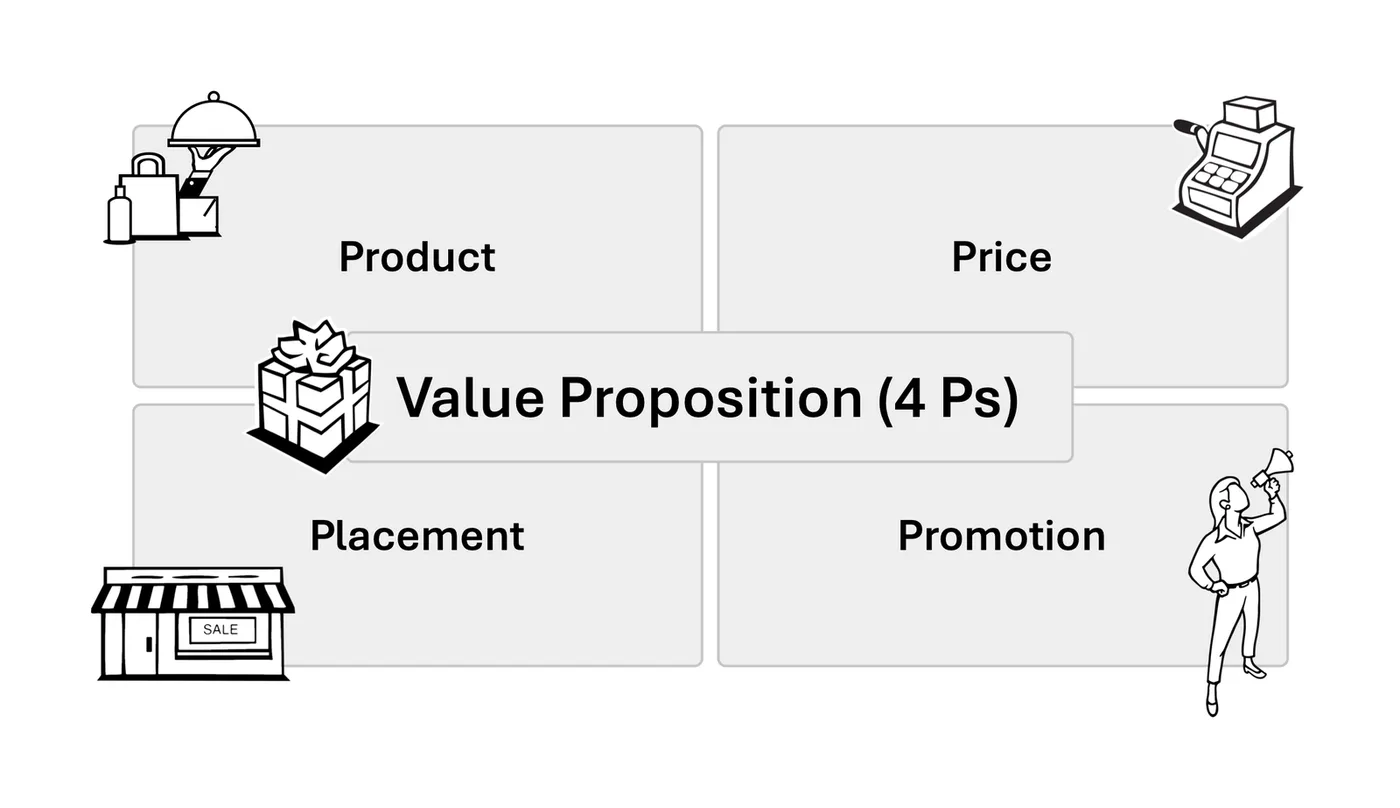
What is Value in Healthcare?
We use Michael Porter's definition: the patient health outcome achieved per healthcare dollar spent. A better healthcare business model produces an informed consumer, better access through an engaged delivery system, and a lower aggregate cost of care.
Keep this in perspective. The party that consumes healthcare is usually not the one who pays for it. The party that pays is best served when it is used less. Those who deliver and supply it are not aligned to limit its cost. Each maximizes its own value at the expense of others. Your business model must avoid this trap. AI will not fix it. Applied to a misaligned system, AI just makes each party better at fighting the others.
Healthcare is a Business
Healthcare is the most extensive business in the United States, and it faces an urgent crisis. According to CMS, U.S. health spending grew 7.2% in 2024, reaching $5.3 trillion, or $15,474 per person. That is 18.0% of GDP. CMS projects growth averaging 5.4% a year through 2034, which would take health spending to 20.6% of GDP. Medicare spending grew 7.8% in 2024 to about $1.1 trillion, and CMS projects it will grow an average of 7.7% a year.
This is unsustainable. The answer lies in taking a page from the business world and treating healthcare as a business. Meanwhile, healthcare remains very complex. It takes enormous coordination and cost to change one person's health trajectory, let alone a population's, and it is hard to get everyone on the same page.
Five Value Drivers
I see shared value as five drivers, tied to the Quintuple Aim. Here is each with its AI implication.
1. Outcomes
Value-based care measures success by outcomes relative to cost. A winning model bridges clinical and financial data to drive quality. AI can read the unstructured record and find the gap in care. That only counts as value if the gap closes. CMS's new ACCESS model is a sign of direction: a ten-year test of technology-supported chronic care where full payment depends on measurable outcomes.
2. Affordability
There are more than 9,000 billing codes, as Christensen noted, but none for helping patients stay well. A winning model shares the burden of cost and puts part of its Revenue at risk on agreed outcomes. Watch out: AI that improves coding can raise total spending even as it pays for itself. That is a win for one party, and a loss for the system.
3. Equity
Dr. King called injustice in health the most shocking inequality. A winning model recognizes that patients are more than the sum of their claims. AI could bring expert guidance to people who never had it, in their own language. It can also learn the biases in the data. Measure performance by population, then fix what you find.
4. Efficiency
A winning model lets providers practice at the top of their license and find joy in care. AI's clearest early evidence is here, though modest. In one large study, ambient scribe adopters generated 1.81 additional RVUs and saw about one more patient per week, with no increase in denials. Another found 16 fewer documentation minutes per eight hours of care. Ask who gets the saved time: the clinician, the patient, or the schedule.
5. Accessibility
A winning model is easy for consumers and providers to adopt, anywhere, at any time. Until healthcare is as easy as Amazon, we are unlikely to stem costs. AI is the first technology with a real chance of answering at 2 a.m. in any language. It must also know when to hand off.
Value Propositions by Stakeholder
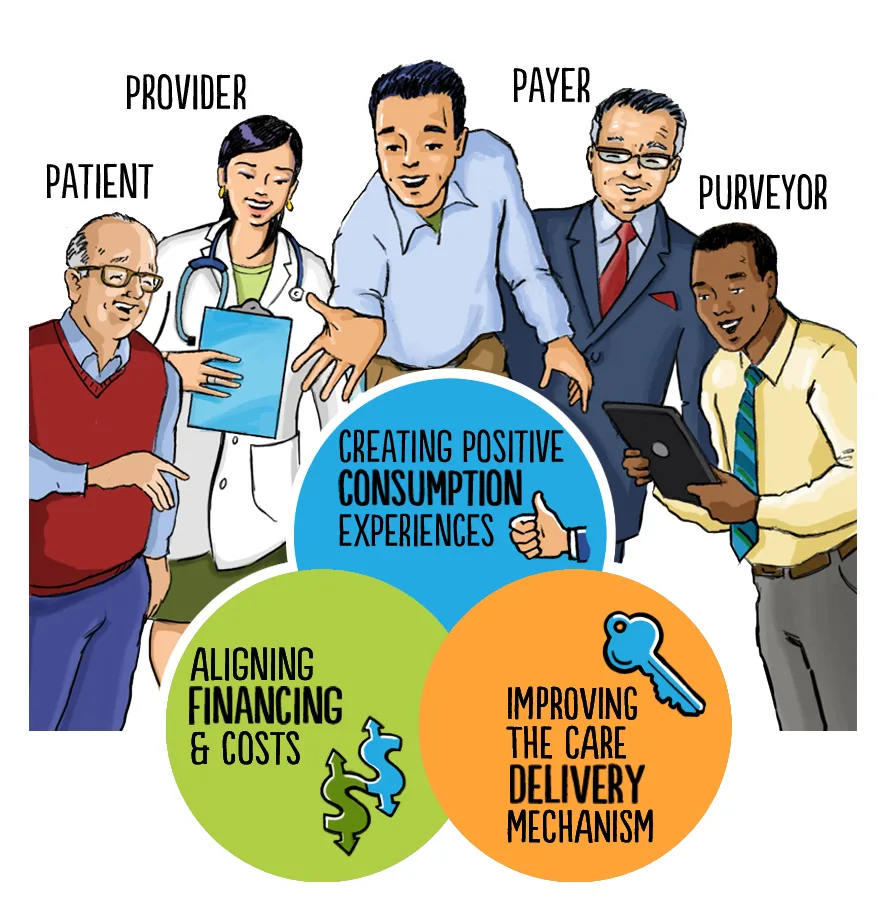
modelH: The Four Stakeholders of Healthcare
Each of the four Ps buys for different reasons.
- Patients buy because a solution meets their JTBD, a Key Influencer persuades them, a Key Partner includes it, or an Intermediary restricts their other options.
- Providers buy because it solves their JTBD, lowers Costs, raises Revenue, or is required by an Externality.
- Payers buy for the same reasons: JTBD, lower administrative or clinical Cost, more Revenue or loyalty, and regulation.
- Purveyors buy for JTBD, cheaper access to Patients, Providers, and Payers, more Revenue, and regulatory requirements such as the FDA's.
AI Is Not a Value Proposition
"AI-powered" says how you do it, not what you promise. Rewrite your statement without the word AI. If nothing is left, you do not have a Value Proposition. You have a demo.
A strong promise now includes something a feature cannot copy: an outcome you stand behind, accountability when you are wrong, or evidence you generated.
New Questions for 2026
- What do we promise that does not depend on the word AI?
- Which of the five value drivers does our AI measurably move?
- Who captures the value: the patient, clinician, payer, or us?
- What do we stand behind when the AI is wrong?
What is Next?
Next, we use Value Proposition Canvasing to find Product-Market Fit.
to your health,
Kevin