

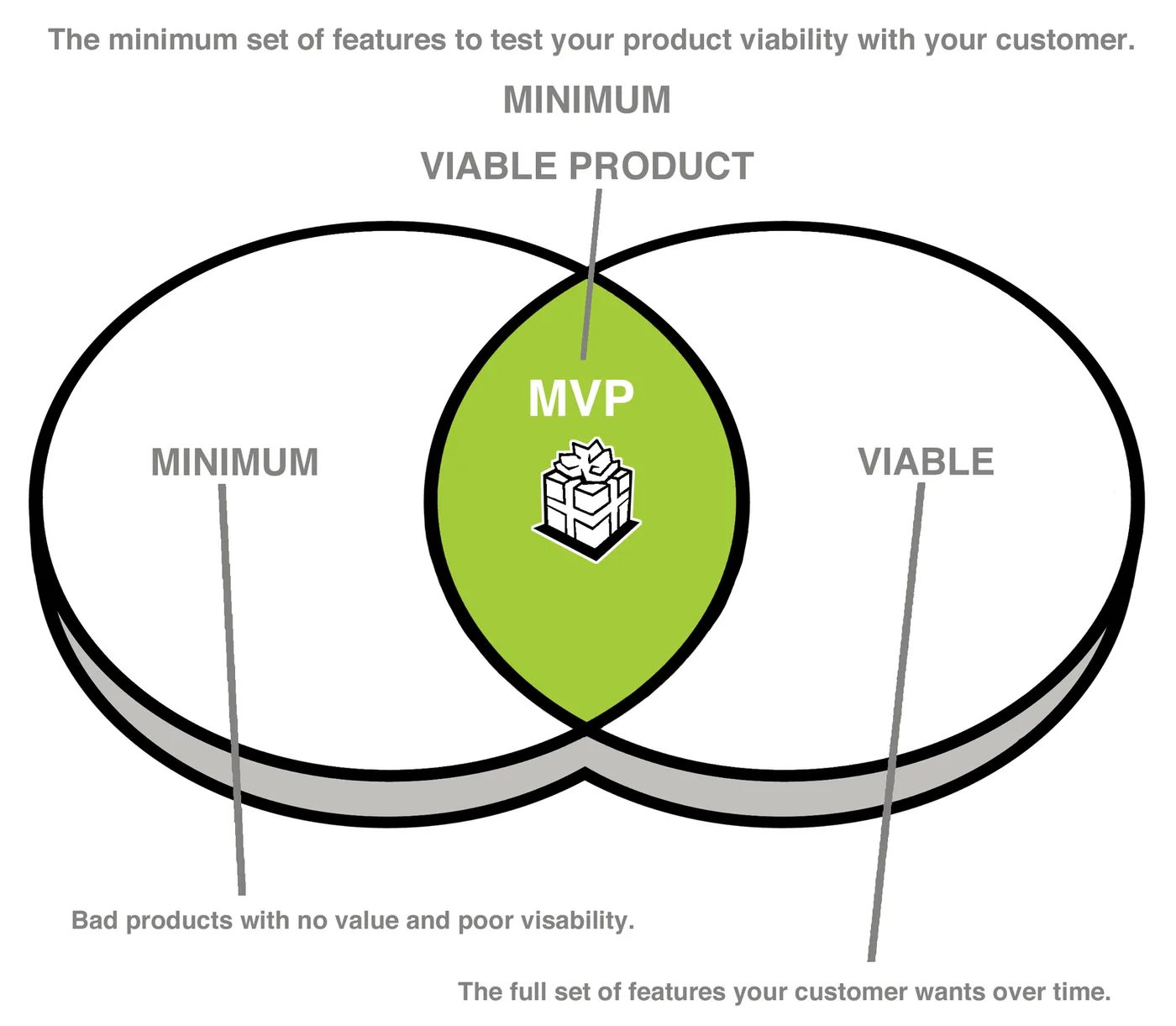
modelH: Minimum Viable Product (MVP)
Eric Ries defines an MVP as the version of a product that lets a team collect the maximum amount of validated learning about customers with the least effort. It is the product built through one cycle of a build, measure, learn loop, as fast as possible.
When I first wrote about MVP, the expensive part was building. Now a small team can produce a working prototype in an afternoon with AI. That is wonderful, and it changes where the risk sits. The constraint has moved from can we build it to should we, and does it hold up with a real patient?
Defining Minimum
Minimum is about speed. Build only what is most valuable to the customer, in order of priority, and fail fast and cheap. Sell the vision first. Include only the features that demonstrate the value exchange and allow a feedback loop.
For AI products, minimum often means narrow. Do one job, for one Persona, in one workflow, with a person checking the output. A manual back end is still fine. Humans doing part of the work teach you where the edge cases are.
Defining Viable
Viable means the product matters to customers, creates a real value exchange, and gets used. If they get it but cannot use it normally, they will not. Design and test with an ideal customer set, since early adopters forgive more and will help you get there.
Here is what viable means in healthcare AI, beyond usability.
- Safe: you tested failure modes for this population and defined when it hands off to a person.
- Compliant: you know how you handle protected health information and whether you are building a device.
- Evaluated: you measure accuracy against a set of real cases, and you re-measure when the model changes.
- Governed: someone is accountable, and the customer's reviewers can see how it works.
This is not a license to skip the MVP. It is the minimum for this industry. A prototype can be fast and scrappy. Anything touching a patient's care cannot.
Defining Product
Hold off on solving the problem until you validate the business hypothesis. Ries outlines four questions.
- Do consumers recognize they have the problem?
- If there was a solution, would they buy it?
- Would they buy it from us?
- Can we realistically build it?
AI answers question 4 with a loud yes much more often than it used to. That makes it easy to skip the first three. Do not. Question 3 is the one that AI has made hardest, because the customer can often get something similar from their EHR or chatbot.
Putting MVP Into Action
- Pre-design the minimum feature set that proves your Value Proposition hypothesis with your ideal customer set. Use GenAI prototyping tools to get to something people can react to.
- Define the value chain that delivers this value, and see if it passes the smell test with Buyers.
- Allow for one full cycle of Build, Measure, Learn.
- Launch to your ideal customers and solicit feedback.
- Lather, rinse, and repeat until you have created a value exchange.
Then add features incrementally, using LeanUX and agile. Test feedback at each release to confirm you have not lost the MVP.
Three Traps
The demo trap. Models are impressive for the first 80% of cases. Healthcare value and risk often sit in the remaining 20%. Test on your messiest data, not your cleanest.
The pilot trap. Cheap pilots are easy to start and easy to leave running forever. Define up front what result makes the Buyer pay, and what result kills it.
The vibe trap. AI-written code can create security, privacy, and maintenance debt faster than a team can see it. Have an expert review anything that handles patient data.
MVP still means testing your hypothesis no matter where it leads, and it may lead to abandoning the idea. That is what fast and cheap are for.
New Questions for 2026
- What are the safety, compliance, and evaluation minimums for this product?
- Where does a person check the AI in this MVP, and when can that change?
- Are we learning from real usage or from an impressive demo?
- What result would make us stop?
What is Next?
Next, we look at why and how to pivot.
to your health,
Kevin