

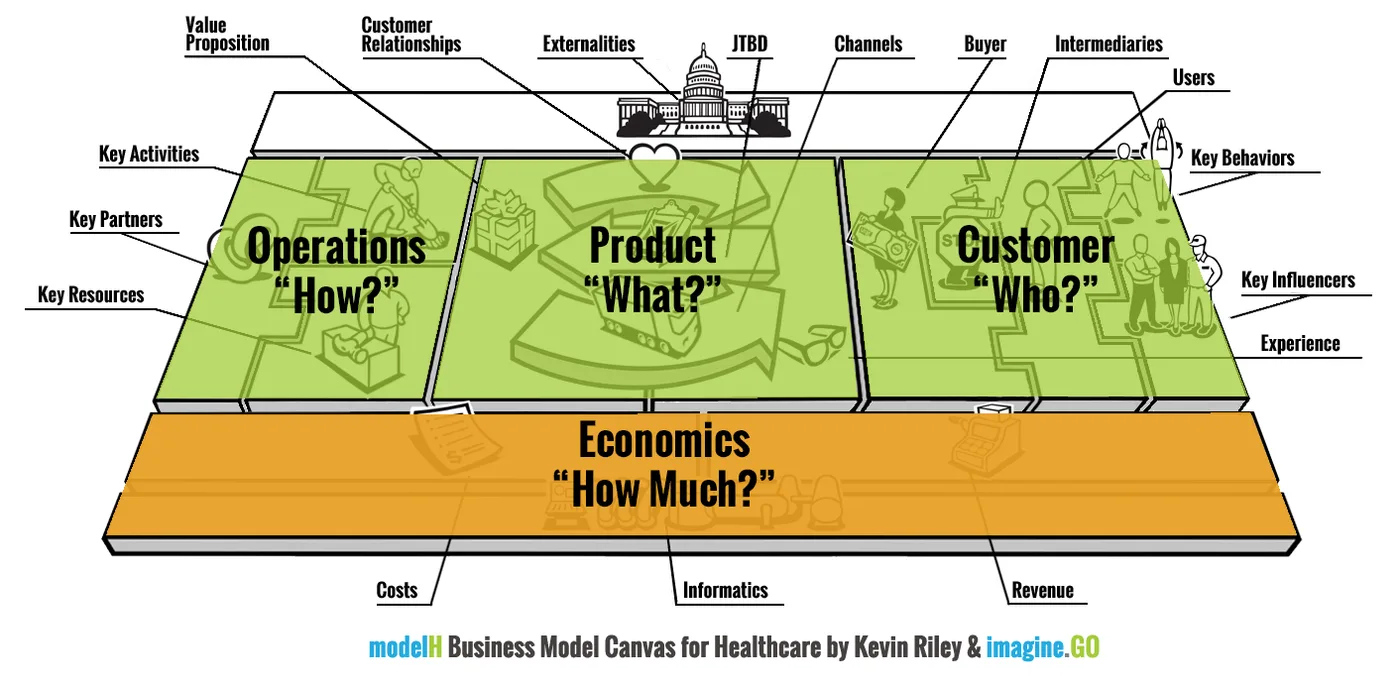
modelH Business Model Canvas: The How Much
The How Much is where a healthcare business model proves itself. Here is what we learned.
- Costs. AI trades labor for compute, oversight, and risk. Count all of it, and ask whether total cost of care really falls.
- Revenue. Move your pricing closer to the work or the outcome, so that you are not punished when your AI succeeds.
- Externalities. Rules, trust, and model progress are all external forces. Monitor them and make them work for you.
One Question Ties It Together
When AI makes this job 90% cheaper, who keeps the difference?
- If competition drives prices down, the customer keeps it.
- If a platform captures it, the platform keeps it.
- If a payer contract adjusts, the payer keeps it.
- If you have something scarce, you keep some of it.
There is nothing wrong with the first answer. It may even be how we finally bend the cost curve, and I would cheer. But you should know the answer before you build a financial model that assumes it is the last one.
A Simple Stress Test
Run your financial model under these scenarios.
- The price of your core service falls by half in two years.
- Your compute cost doubles because usage grows faster than prices fall.
- A major platform bundles your main feature for free.
- A regulator requires you to add a human review step.
- Your outcomes contract pays only 70% of what you projected.
If any of these kills the company, go back to the canvas.
What is Next?
That is all 17 blocks, more than a decade after we first drew them. There is one more, and it is new: AI Proof.
to your health,
Kevin