

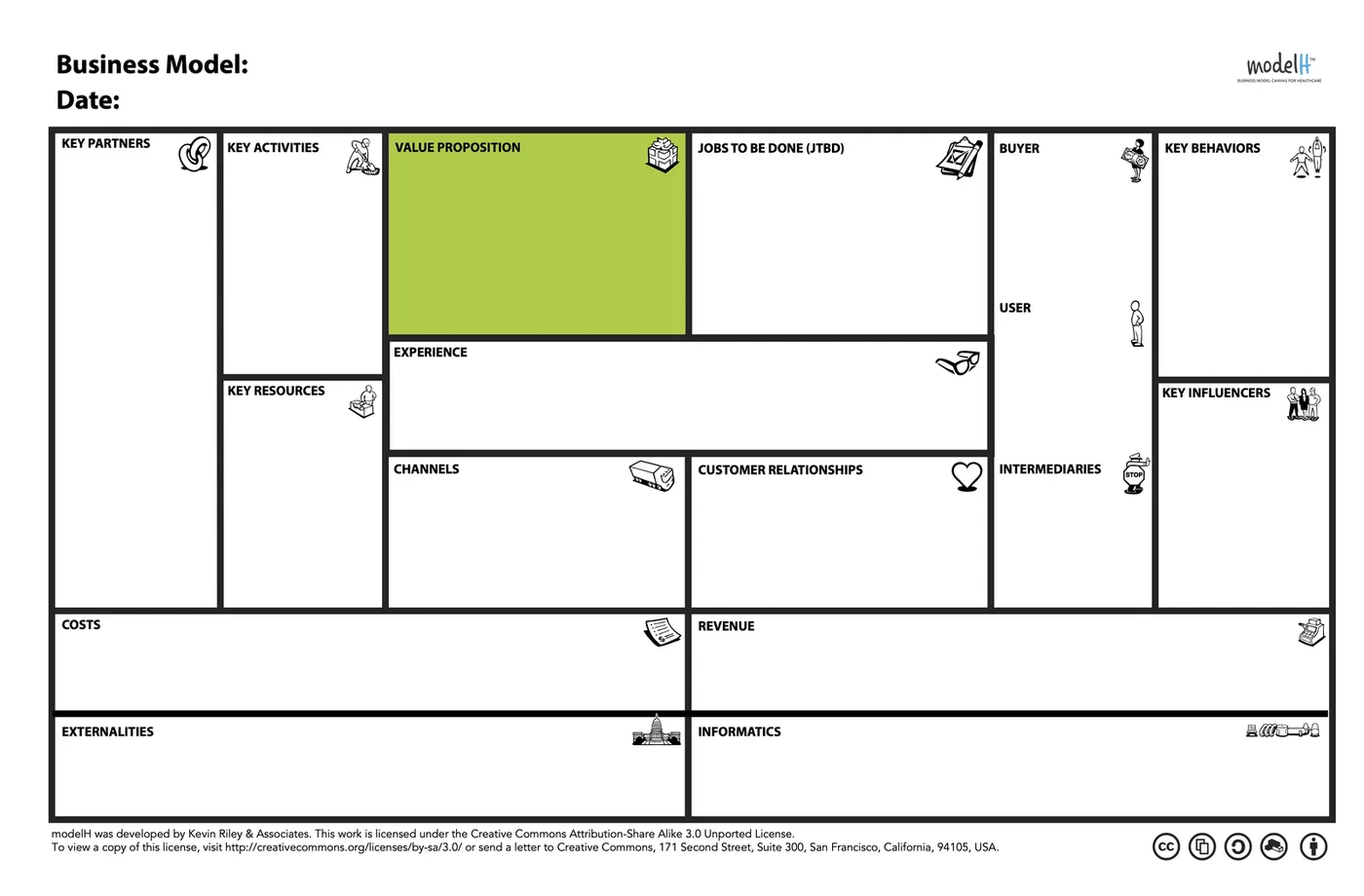
modelH Business Model Placemat: Value Proposition
A Value Proposition is the set of unique benefits an organization offers its customers, and it is why they choose you. It can rest on cost, quality, access, experience, and more. Here are the four key messages.
1st: Establish a Position of Value with Someone Specific
Reach a point where a clearly identified Buyer and User knows you offer something valuable and relevant to their health JTBD. Focus on what matters most when they decide. These are Value Drivers, and they can be known or unknown to the customer. Build to match them.
AI update: "Everyone who could use AI" is not a someone. Be specific.
2nd: Increase Your Understanding of that Value Position
Commit to Customer Intimacy: occupy a few high-value niches and obsess over them. Turn prospects into customers willing to share personal and health information in a two-way exchange.
AI update: this understanding may be your most durable asset. Models commoditize general knowledge. They cannot commoditize what your customers chose to tell you. Treat that trust with great care.
3rd: Develop Your Product-Market Fit Iteratively
Identify the offerings most aligned to the JTBD of your Buyers and Users, and keep shaping them using an MVP approach. Your Value Proposition must also work for Intermediaries and Key Partners.
AI update: building is cheap, so learning is what counts. And PMF now expires. Re-test it as the models and competitors change.
4th: Pivot When You Need To
Use Porter and Blue Ocean thinking to stay clear on who you are and how customers see you. Use levers to fine-tune and pivots to re-align.
AI update: run the exercise more often. Annual strategy reviews are too slow for a market where a feature can become free in a release cycle.
A One-Minute Test for Your Value Proposition
- Say it without the word AI.
- Name the specific customer.
- State the outcome you stand behind.
- Explain why a free AI tool would not replace it.
- Show your evidence.
What is Next?
To finish the What, we cover Experience, Channels, and Customer Relationships in six posts: Experience, Journey Mapping and its tools, Channels, Channel Threading, Customer Relationships, and a wrap-up. I promised these in 2024. Better late than never.
Some good additional reading:
- What Is Value in Health Care? by Michael Porter
- The Discipline of Market Leaders by Michael Treacy and Fred Wiersema
- The Lean Startup by Eric Ries
- modelH Business Model Canvases
to your health,
Kevin