

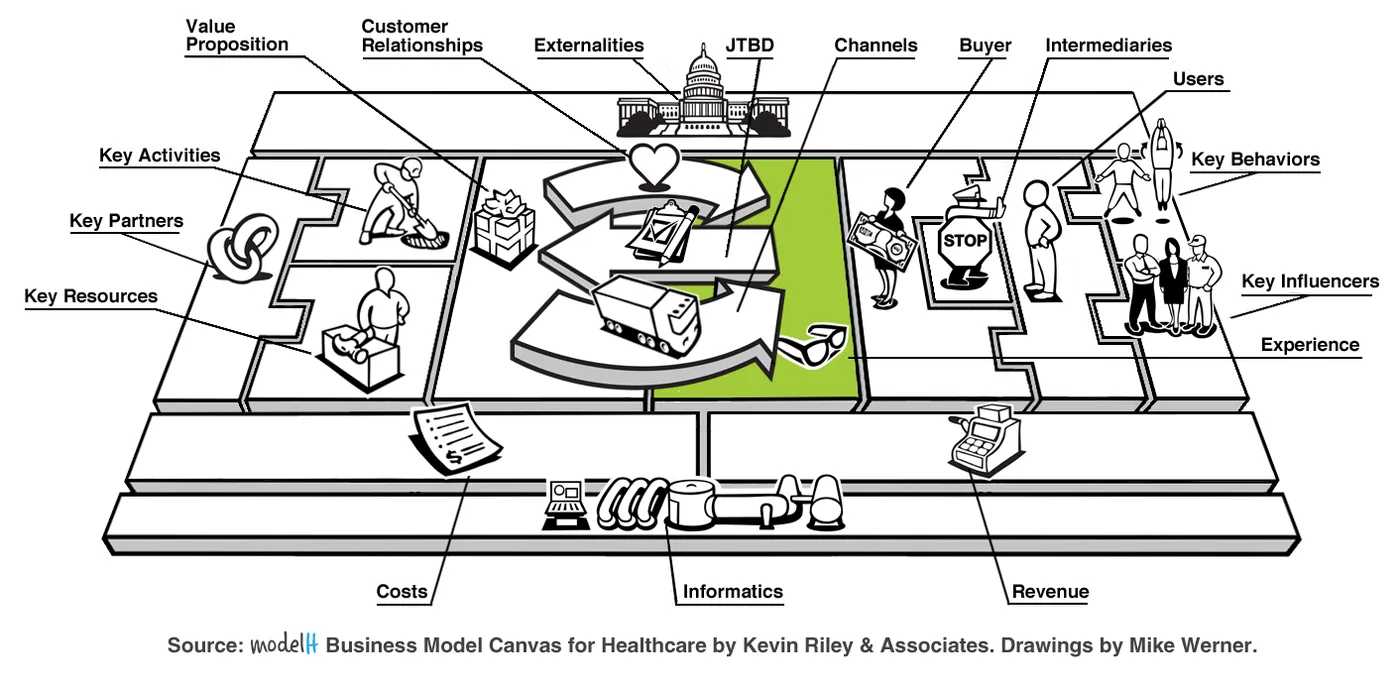
modelH Business Model Canvas: Experience
Experience is how Buyers and Users perceive your Channels and Customer Relationships. It is not a block you see in most business models. Back in 2013, I was not sure it belonged in ours. If the Customer Segment is the most important part of your model, though, its experience must count for a great deal. It stayed.
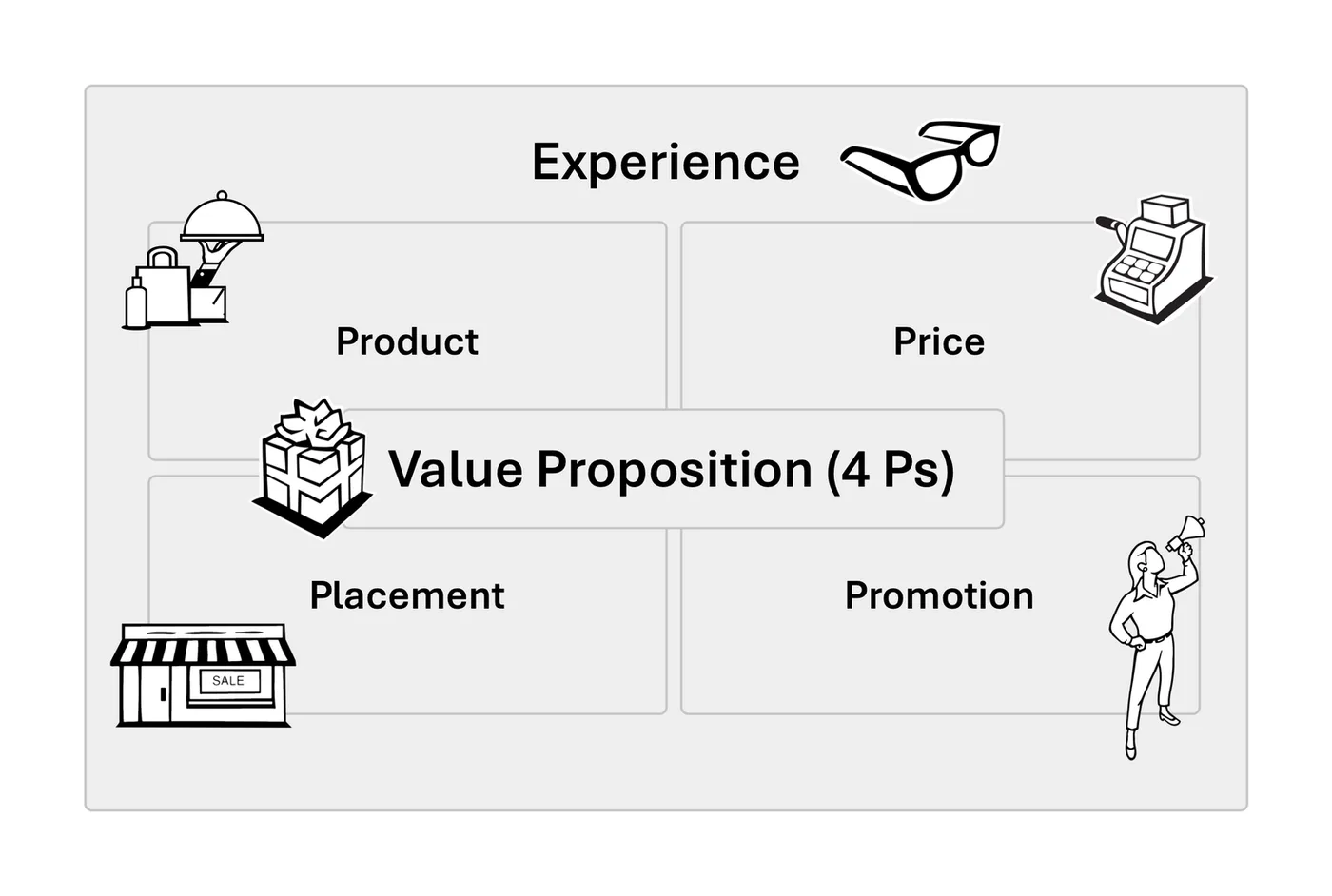
Too many healthcare companies are unaware of or indifferent to the experience they create. Every touch forms a positive or negative connection, and few organizations consider the whole rather than a point in time. In healthcare, experience can be the difference between healthy, profitable customers and unhealthy, expensive ones. Great experience produces action (behavior change), satisfaction (happiness), and attraction (loyalty). It is also the fuel for hard Key Behaviors.
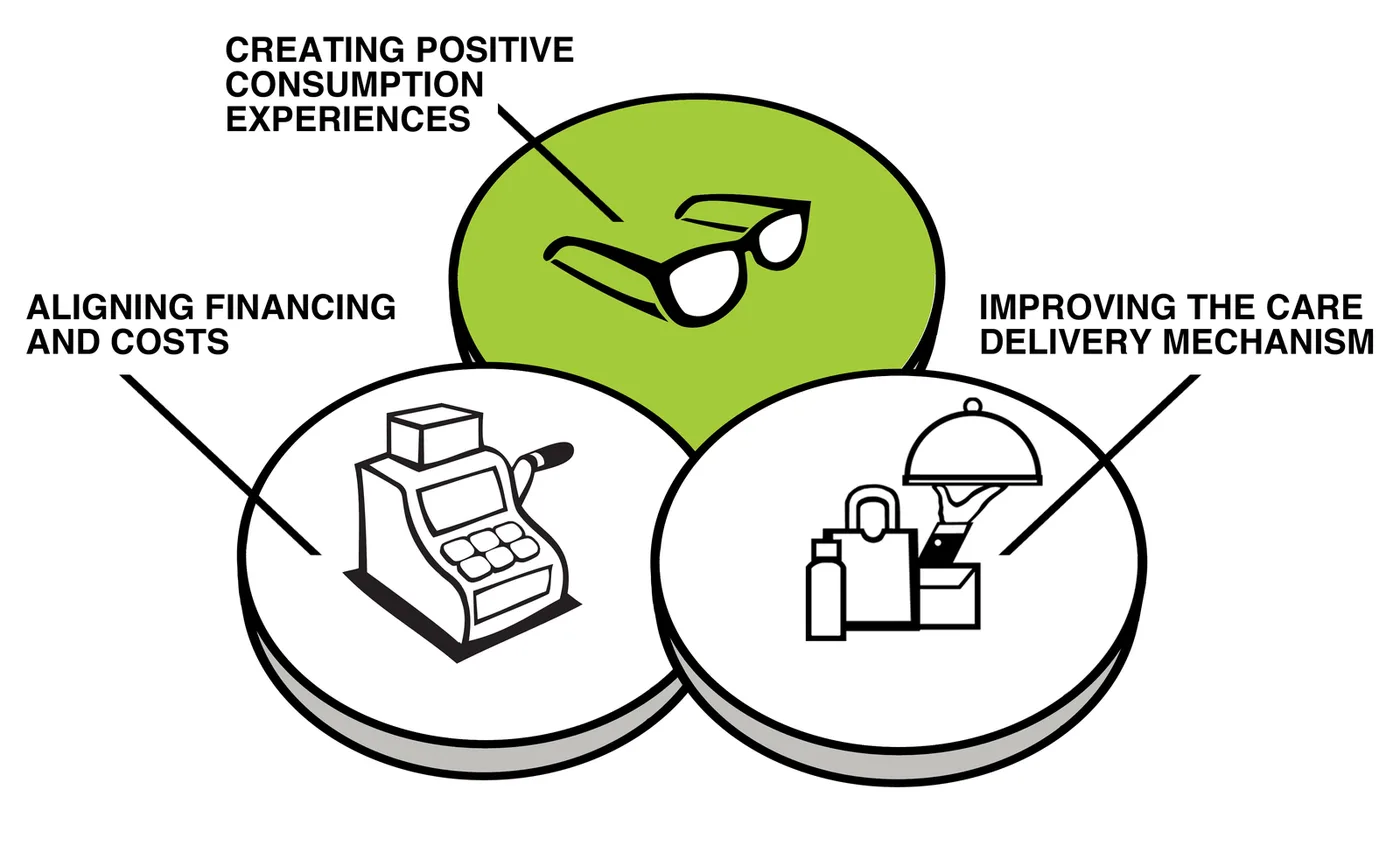
modelH: Healthcare Ecosystem and Experience
What AI Changes
Expectations jump. People now get a patient, instant, plain-language answer from a general AI tool. Then they call a health plan and wait on hold. That gap will define the next decade of healthcare experience.
Personalization is affordable. Experience used to be built for the lowest common denominator because tailoring was too expensive. AI can now change the reading level, language, and sequence for each person.
Bad experience can be scaled too. A wrong answer delivered confidently is worse than a slow right one. A bot that traps you in a loop is worse than hold music. A note written by AI that a doctor did not read is a broken promise.
Some experience vanishes. When an agent handles a task, the best experience may be no experience at all. Hassles disappear. Remember that the hassle sometimes included the moment when a person noticed something was wrong.
Questions for the Experience Block
- What is the lowest common denominator Experience your Customer Segment expects?
- Where do you exceed those minimum expectations, and where do you miss?
- Which of your Key Activities drive your Experience?
- Which parts of your model create hassles for your Customer Segments?
- What makes it hard for them to find you?
- How do they feel about you, and how easy are you to work with?
- What keeps them from recommending you, or from moving their business elsewhere?
- Where do hassles keep Buyers from buying or Users from using?
- Where do you waste their time or money, or require unnecessary steps?
- Where do you create confusion or avoidable risk?
LCD and MVP
Build for two lines at once.
- The Lowest Common Denominator (LCD) is the version that lets anyone complete a value exchange with the least build or staff and an acceptable experience.
- The Minimum Viable Product (MVP) is the version that creates an intentional exchange with a specific set of customers and a great experience.
With AI, the LCD now includes these: an accurate answer, a clear way to reach a person, and honesty that it is AI.
Six Design Questions
Adapted from Fred Wiersema, these test whether you are in tune with your customers.
- Can my customer find me? This used to be about search rank. Now also ask what AI assistants say when someone describes their problem.
- When they find me, is it unique and memorable? Does it connect to their JTBD and remove barriers?
- Do my processes get in the way of a purchase? Walk the process yourself, step by step.
- Do I send unintended messages? Boilerplate reads like a legal gotcha. So does an obviously automated apology.
- Are my products intuitive? Avoid too many options. A conversation can hide complexity, but only if it works.
- Are my channels threaded? Same customer, same data, same promise.
How to Measure Experience
Do not rely on Net Promoter Score and call it a day. Connect Experience to Revenue and Costs.
- Strategy and culture: is it in the strategy, and in every executive's goals?
- Brand: loyalty, trust, and likelihood to recommend.
- Process: journey maps, standards, and regular experience audits.
- Revenue: wallet share, lifetime value, new sales from word of mouth.
- Costs: retention, churn, cost to serve by channel, and cost to serve over revenue.
- Customer: Customer Effort Score, speed to resolution, complaints, and understanding of what you told them.
For AI, add these: containment that counts only when the problem was actually solved, escalation rate, error rate by population, the rate at which clinicians edit AI output, and whether customers know they were dealing with AI. Watch "containment" closely. A customer who gives up looks like a success on the dashboard.
New Questions for 2026
- Where is an AI experience now our customer's benchmark?
- How quickly and easily can a person reach a human, and at what moments must they?
- How do we detect a confident wrong answer?
- Which hassles did AI remove, and did any of them serve a purpose?
- Do we disclose when customers are dealing with AI?
What is Next?
Next, we look at the tools for designing great Experience.
to your health,
Kevin