

In the U.S., healthcare is a business. It organizes doctors and patients into a system where complex care and financial relationships run between hospitals, clinics, health insurers, pharmaceutical companies, and medical device manufacturers. When you view it through the lens of value creation, all those players can interoperate better and improve outcomes for everyone.
A business model is the plan for how a company creates, delivers, and captures value. If your employees do not understand yours from top to bottom, you risk wasting precious time doing busy work rather than growing your business. Everyone does not need to do every job. Each cog needs to understand how it powers the others.
Here is what is new. AI can now generate busy work faster than any team in history. It will produce the deck, the pilot, the dashboard, and the 40-page strategy overnight. A company without a clear business model will simply do more of the wrong things, at higher speed, with more confidence.
A Quick Trip Down Memory Lane
In 2012 and 2013, I worked with more than 300 healthcare experts worldwide to co-create an open-source business model canvas for our industry. We built on Alex Osterwalder's outstanding Business Model Canvas, then adapted it for the multi-sided reality of healthcare. The result was modelH, which we shared through Creative Commons. It is heartening that it is used in some universities to teach healthcare entrepreneurship.
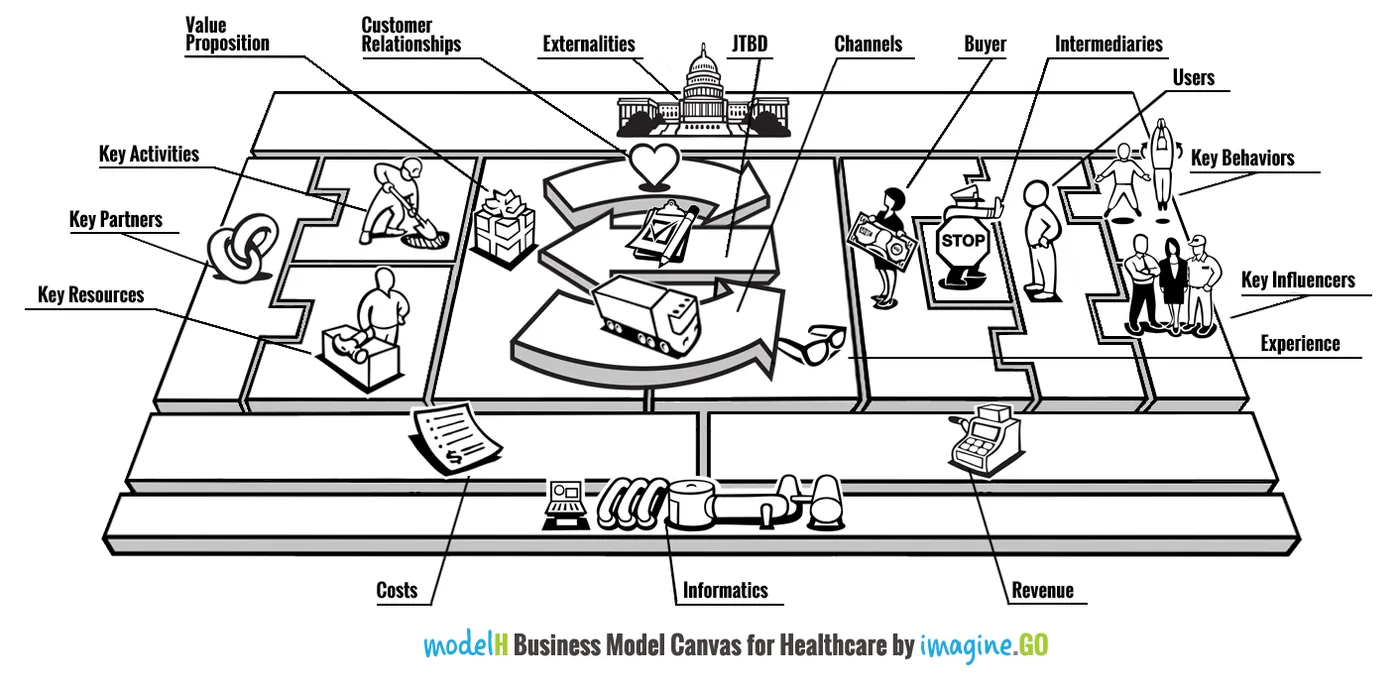
modelH Business Model Canvas for Healthcare
What Makes a Good Business Model in Healthcare and Life Sciences?
When I say "good," I mean sustainable value creation. And I cannot improve on Michael Porter's definition: value is the patient health outcome achieved per healthcare dollar spent.
More value comes from the Triple Aim: better patient experience of care, better population health, and lower per capita cost. Still more comes from the Quintuple Aim, which adds clinician wellbeing and health equity. AI can move all five. It can also hurt all five, for instance if it speeds up denials or works worse for the people the system already underserves. So measure it against the aims, not against its demo.
These are the characteristics I look for, each with its 2026 test.
- Customer focus: you solve a defined customer's problem. 2026 test: do you start with the customer's job, or with what the model can do?
- Product-market fit: your Value Proposition meets an underserved need. 2026 test: will that need still be underserved when your customer's EHR ships the same feature?
- Profitability: the model makes money. 2026 test: do your margins survive AI's usage costs and the oversight it requires?
- Scalability: you keep your promises as you grow. 2026 test: when AI handles 100 times the volume, who is accountable for the errors?
- Flexibility: you can adapt to regulation, technology, customers, and the economy. 2026 test: can you swap models and change workflows without rebuilding the company?
The Building Blocks
modelH uses 17 building blocks across four business functions. For 2026, I am adding one more.
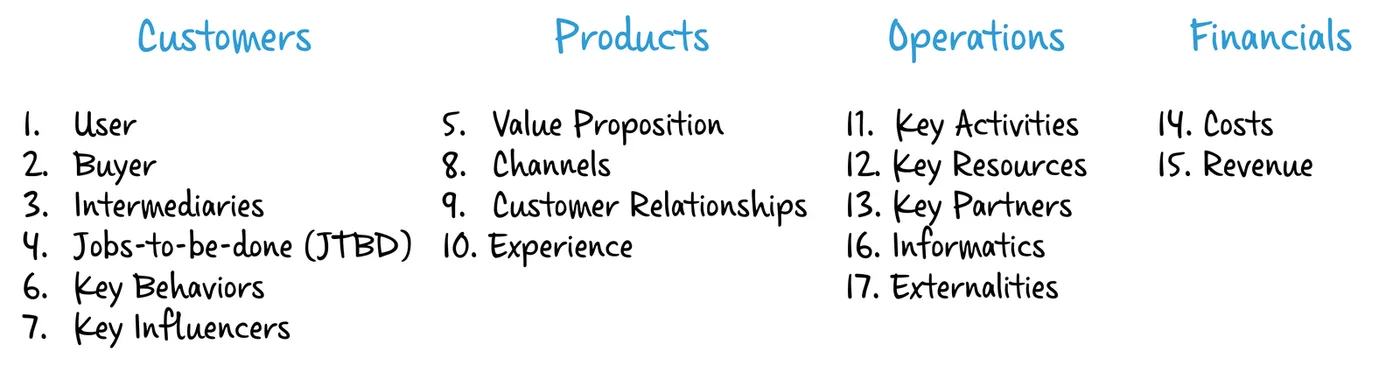
modelH Building Blocks by Business Function
Customers (The Who)
- Users are the customers that a business model serves.
- Buyers are the customers a business model sells to and may also be Users.
- Intermediaries affect how a Value Proposition is seen and paid for by the Buyer.
- Jobs-to-be-Done (JTBD) are high-level goals the customer tries to accomplish.
- Key Behaviors are the activities required of the User to complete their JTBD.
- Key Influencers affect the User's understanding and ability to complete their JTBD.
Products (The What)
- Value Propositions are products and services offered to customers to solve their JTBD.
- Channels are how a company brings its Value Proposition to market.
- Customer Relationships are connections a company creates with its Buyers and Users.
- Experience is how Buyers and Users perceive Channels and Customer Relationships.
Operations (The How)
- Key Activities are the most important tasks in creating the Value Proposition.
- Key Resources are the internal actors required to deliver the Value Proposition.
- Key Partners are the external actors required to deliver the Value Proposition.
- Informatics is the data and analytics needed to deliver and measure the Value Proposition.
Financials (The How Much)
- Costs are the most important financial drivers of a business model.
- Revenue is the way a company makes money from its customers.
- Externalities are the external forces and regulations imposed upon a business model.
New for 2026
- AI Proof is how a company becomes AI-native in how it works, then AI-proof in how it makes money.
A Simple Test
Ask five people in your company to answer these questions without looking anything up. Who pays you? Who uses what you make? What job do you do for each of them? What would you still sell if every competitor had your AI tomorrow?
If you get five different answers, you are running a busyness model.
What is Next?
We go block by block, starting with the most important part of the canvas: the Who.
You can read all about modelH on Medium.
to your health,
Kevin