

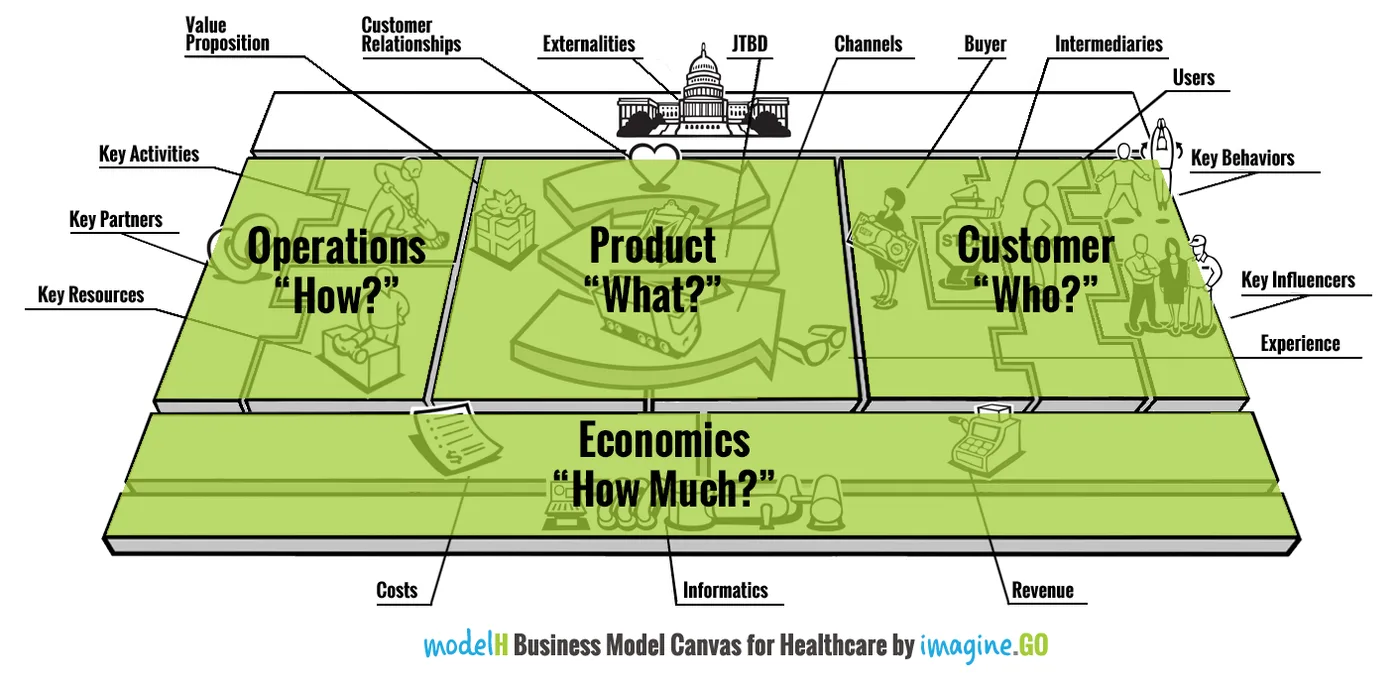
modelH Business Model Canvas: Who, What, How, and How Much
In 2024, I started a 10-year revisit of modelH. Then the ground moved. So I am going back through all of it with one new question on every block: what does AI change here?
AI changes the economics of every block on the canvas. It doesn't change who your customer is, and it doesn't change what value means.
My short answer is that AI makes thinking cheap. It lowers the cost of reading, writing, summarizing, coding, and reasoning across most of the work healthcare companies are organized around. That sounds like an operations story. It is really a business model story, because a great many healthcare business models are built on the fact that this work used to be expensive.
What Has Already Happened
This is no longer a forecast.
- Patients moved first. KFF found that 29% of Americans use AI at least monthly for health information and advice, up from 17% in 2024. Rock Health found health chatbot use doubled in a year, from 16% to 32%.
- Clinicians followed. 1,744 U.S. hospitals on Epic, nearly two-thirds, had deployed ambient documentation by mid-2025.
- Features became free. athenahealth launched its own ambient tool, and Epic announced AI Charting, which puts pressure on every standalone scribe vendor. That is a business model lesson in one sentence.
- Regulators started using it. CMS began the WISeR model on January 1, 2026, testing AI-assisted prior authorization in traditional Medicare in six states.
- Life sciences repriced it. AI drug discovery partnerships in 2025 carried $43.4 billion in potential value across 114 deals. Yet one review found no consistent reduction in clinical trial duration.
That last pair is the whole story. Money and capability are moving fast. Human biology, regulation, and trust are not.
What Gets Cheap and What Stays Scarce
I use this distinction with every block now.
Getting cheap: documentation, summarization, coding, first drafts, chart review, outreach, routine analysis, and the first version of almost any software.
Staying scarce: clinical and legal accountability, proprietary outcomes data, trusted relationships, distribution, permission to act inside a workflow, evidence that holds up, and the willingness to carry financial risk.
If your margin depends on the first list, you have a problem. If your value lives in the second list, AI is a tailwind.
What Changes on the Canvas
The 17 blocks stay. AI gets baked into each of them through new questions. Here is the headline for each.
The Who
- Users: some of your Users will now arrive with an AI, and some will be an AI.
- Buyers: Buyers now ask what you do that their EHR or their chatbot will not do for free.
- Intermediaries: AI removes old middlemen and creates new ones.
- Jobs-to-be-Done: the job stays. The way people get it done is up for grabs.
- Key Behaviors: you can now personalize the nudge. You still cannot do the behavior for them.
- Key Influencers: the chatbot has joined the family doctor and the daughter with the app.
The What
- Value Propositions: a feature can be copied in weeks. A promise with accountability behind it cannot.
- Channels: the conversation is becoming a channel, and you may not own it.
- Customer Relationships: AI can scale care and attention, or fake it.
- Experience: the bar is now set by the best AI your customer used this morning.
The How
- Key Activities: map the work, then decide what is automated, assisted, or human.
- Key Resources: a new mix of people, models, and proprietary data.
- Key Partners: your model vendor is now a critical supplier with real leverage.
- Informatics: moves from measuring the business to running it.
The How Much
- Costs: labor shifts toward compute and oversight, and AI costs are variable.
- Revenue: pressure moves from selling seats toward selling work and outcomes.
- Externalities: the rules are changing while you build.
Why an 18th Block
Adding AI questions to 17 blocks tells you how AI touches each part of your model. It does not tell you whether the company as a whole will survive it. So I am adding one block, and I do not do this lightly. We argued for a year about the original 17.
AI-Proof is how a company 1st becomes AI-native in how it works, then AI-proofed to survive the very real chance it gets pushed out by a model company or a truly AI-native startup.
The order matters. First you rebuild how the work gets done. Then you ask the harder question: if every competitor has the same models, and your customer's own AI can do the job, why would anyone still pay you? I cover this block in a post of its own at the end of the series.
What Does Not Change
The premise I wrote in 2013 still stands.
- If you know your customers,
- you can get them what they want and need,
- and delight them in the process.
- Then go back to step 1 and see what has changed.
AI is not a customer segment. It is not a value proposition. Nobody ever woke up with a job to be done called "use more AI." I said in 2024 that running around yelling VBC and AI without doing the customer work was a cop-out, and it still is. Value is still Michael Porter's definition: the patient health outcome achieved per healthcare dollar spent.
AI changes what is possible and what is expensive. The canvas is how you decide what to do about it.
What is Next?
We start with the pinned post that opened this revisit, rewritten for 2026, then go block by block through all four parts of the canvas.
To your health,
Kevin