

Defining Customer Segments in modelH
Too often, product owners launch before validating a real need and a market large enough to justify the expense. Just because you can does not mean you should. AI makes this more tempting, because the cost of building has dropped so far. Cheap building does not create demand.
Speed to market cannot bypass five questions.
- Who is your customer?
- How will you serve them?
- Do they want what you offer?
- Are they ready and willing to pay for it?
- How many of them are there?
Rules for the Customer Segment Block
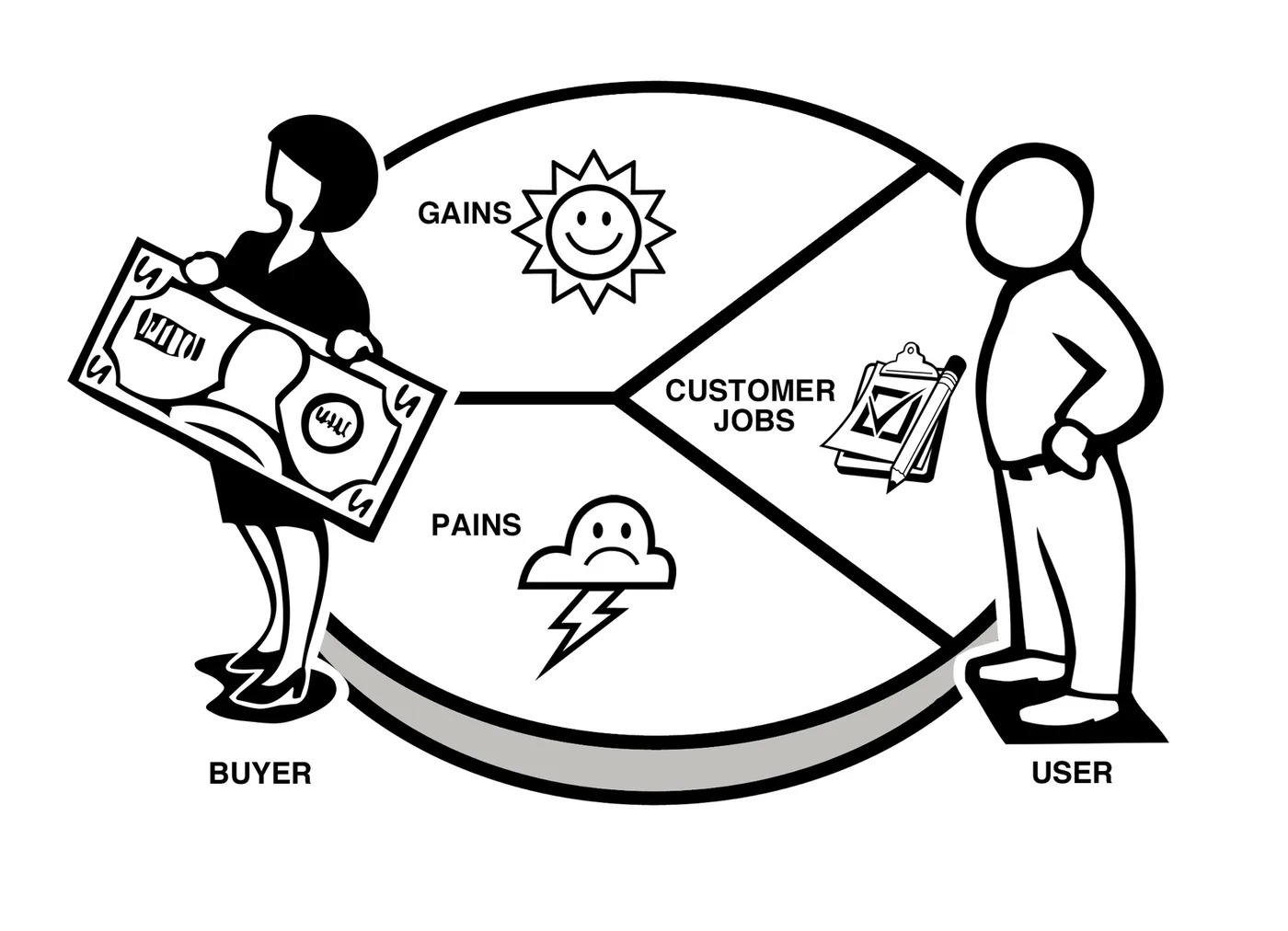
When the User and Buyer differ, which they usually do in healthcare, the business model splits into two or more paths. You need two Relationships, two Channels, and two Value Propositions.
- Users should always be considered individuals: a consumer, an end user at a business, or both.
- Buyers can be Users in a direct-to-consumer model. In an enterprise model they are a business or government entity.
- Users and Buyers have different motivations, and each needs its own Value Proposition.
- Intermediaries act in conflict with or to the benefit of the Value Proposition, the Buyer, and the User.
Questions for the Canvas
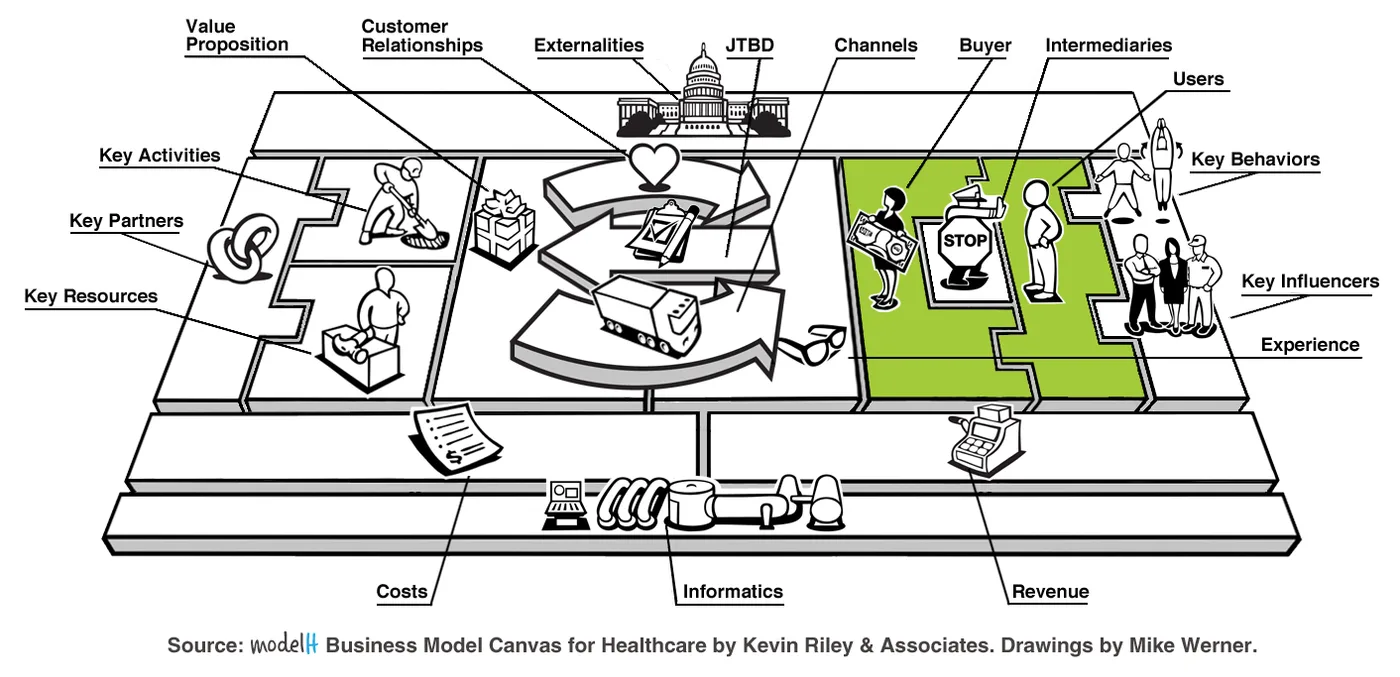
modelH Business Model Canvas: Customer Segments
Start with Osterwalder's questions.
- For whom are we creating value?
- Who are our most important customers?
- What type of market is this: mass, niche, segmented, diversified, or multi-sided? (Hint: healthcare is almost always multi-sided.)
- How big is the addressable market, and how big is our potential market?
Then add the ones unique to healthcare.
- Is the User of our product, or its derivative, also the Buyer?
- What is the relationship between the Buyer and the User?
- What does the market call the User: Patient, Provider, Member, Insurer, or something else?
- What are the total addressable market (TAM), the serviceable addressable market (SAM), and the target market (TM) for your first release?
- How do you define your Buyers as a Persona? How do you define a lead, and how do you define a customer?
- How do you define your Buyer's and User's Jobs to be Done?
- What model distinguishes User types: Archetype, Life Condition, Life Style, or Life Stage?
Estimating Market Size
Total Addressable Market multiplies the number of potential customers by the average revenue per customer. These are the variations I use.
- Total Market Opportunity (TMO): demand across all potential buyers for the broadest set of similar solutions.
- Total Addressable Market (TAM): revenue if you captured every organization your solution directly addresses.
- Total Serviceable Market (TSM): the portion you can realistically reach and serve.
- Market Sizing Opportunity (MSO): a bottoms-up view of what you can capture in the short term.
Explore what they pay now, how they pay now, and how they would prefer to pay.
How AI Changes the Math
AI can change a market sizing in both directions, so model both.
It can shrink your market. If your price is based on labor that AI now does cheaply, your revenue per customer may fall even as usage rises. Ambient documentation is the cautionary tale. A 2025 Peterson Health Technology Institute report described about 60 scribes being implemented and suggested an over-capitalized segment. Then EHR vendors began bundling their own tools. A market can look large right up until the incumbent includes your product at no extra charge.
It can grow your market. If a service was too expensive to deliver, AI may let you serve people you could not afford to reach, such as smaller practices, rural patients, and low-margin segments. Software budgets are not the only pool any more. Some AI products compete for labor budgets, because they do the work rather than helping someone do it.
Use AI to speed up the desk research, then check every number that matters against a primary source. Models will produce a beautifully formatted market size that nobody can trace.
New Questions for 2026
- Does this market still exist at this price if AI does part of the job?
- Which segments become reachable because AI lowers cost to serve?
- Are we selling into a software budget or a labor budget?
- What happens to our TAM when a platform bundles this for free?
What is Next?
Next, we look at how to segment healthcare customers and build Personas.
to your health,
Kevin