

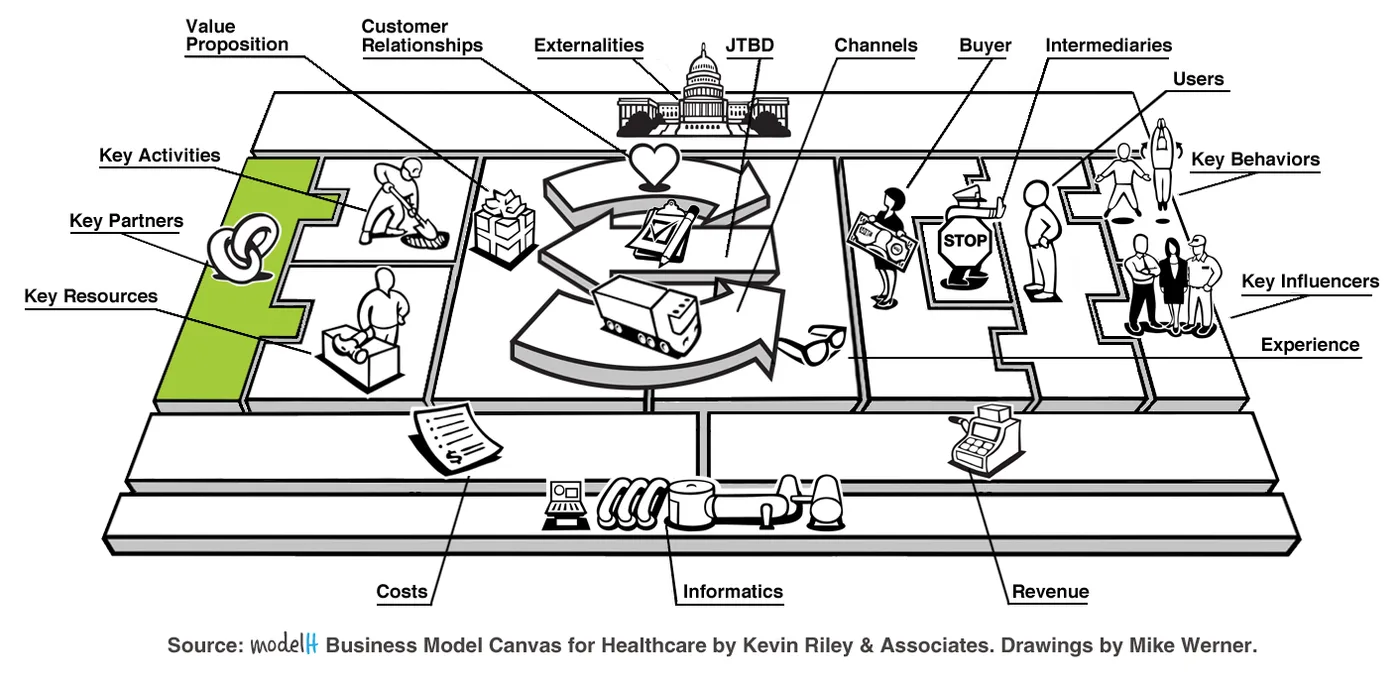
modelH Business Model Canvas: Key Partners
Key Partners are the external actors required to deliver the Value Proposition. An alliance is a relationship formed to tackle a common objective while each company stays independent. Partnerships range from simple Channel deals to joint ventures. Business models use them to reduce costs, enter new markets, cut launch times, improve R&D, and improve quality and experience.
Questions for the Key Partners Block
- Who are our Key Partners, and what do they do for our business model?
- Which Intermediaries do we need to make into Key Partners?
- Which Key Influencers do we need to make into Key Partners?
- Which Key Resources are we acquiring from partners?
- Which Key Activities do they perform?
Forming and Managing a Partnership
Partnerships usually fail because the partner's work does not connect to the business model. Three steps help.
- Define how the partner fits on your canvas and what you will measure.
- Select on commitment and fit, both today and as you grow.
- Sign a clear agreement with protocols for measuring mutual performance.
Then manage the partnership as you would your own Key Activities. Build internal alignment, establish ground rules, name a dedicated alliance manager, audit the relationship, and plan for change. In 2013 I drew on Vantage Partners' work on alliance management, and it still holds.
The New AI Partner Stack
Most healthcare companies will not build their own foundation models. They will depend on several new layers of partners.
- Foundation model providers
- Cloud and computing providers
- EHR and workflow platforms
- Data, interoperability, and clearinghouse networks
- Application and agent vendors
- Evaluation, security, and governance vendors
The stack has many layers. You do not need to master all of them, though you should know which ones can hurt you.
What to Watch For
Concentration. If one partner provides your intelligence, your data, and your distribution, they have a lot of power over your margins. Keep the ability to switch models.
Partners who become competitors. Your EHR marketplace, your cloud provider, and your model vendor may all launch something that looks like your product. Ask what they would need from you if they did, and make sure the answer is something.
Data rights. Who owns the outputs? Can the vendor train on your data? What happens at termination? For health data, these questions go well beyond boilerplate. Get them in writing.
Accountability. When an AI output harms someone, who is responsible: the vendor, the deployer, or the clinician? Your customer will come to you first. Spell out indemnification and how you will audit. Medical Economics reports that with AI documentation today, the physician, not the technology, bears responsibility.
Model change. A vendor update can change your product's behavior overnight. Require notice, and re-test.
Life Sciences: Partnership Is the Business Model
In drug discovery, the partnership itself is often how money is made. Upfront payments of $30 to $50 million are common, with Lilly-Isomorphic at $45 million, while headline values depend on milestones. As that source puts it, pharma pays for access rather than certainty. Absci, meanwhile, chose not to run later-stage trials on one early program and is exploring partnering or out-licensing. Biobucks are not revenue. Model the upfront, not the headline.
Influencers and Intermediaries Still Belong Here
The original modelH insight still stands. Most companies miss the chance to make Key Influencers and Intermediaries into real partners. AI lowers the cost of doing this. You can equip a caregiver, a community health worker, or a benefits navigator with tools once available only to large organizations.
New Questions for 2026
- Which AI partners could hurt us by leaving, raising prices, or competing?
- How quickly could we switch model providers?
- Who has rights to our data and outputs?
- Who is accountable when a partner's AI is wrong?
- What do partners need from us that they cannot get elsewhere?
What is Next?
Next, we look at the block I fought hardest for in 2013: Informatics.
to your health,
Kevin