

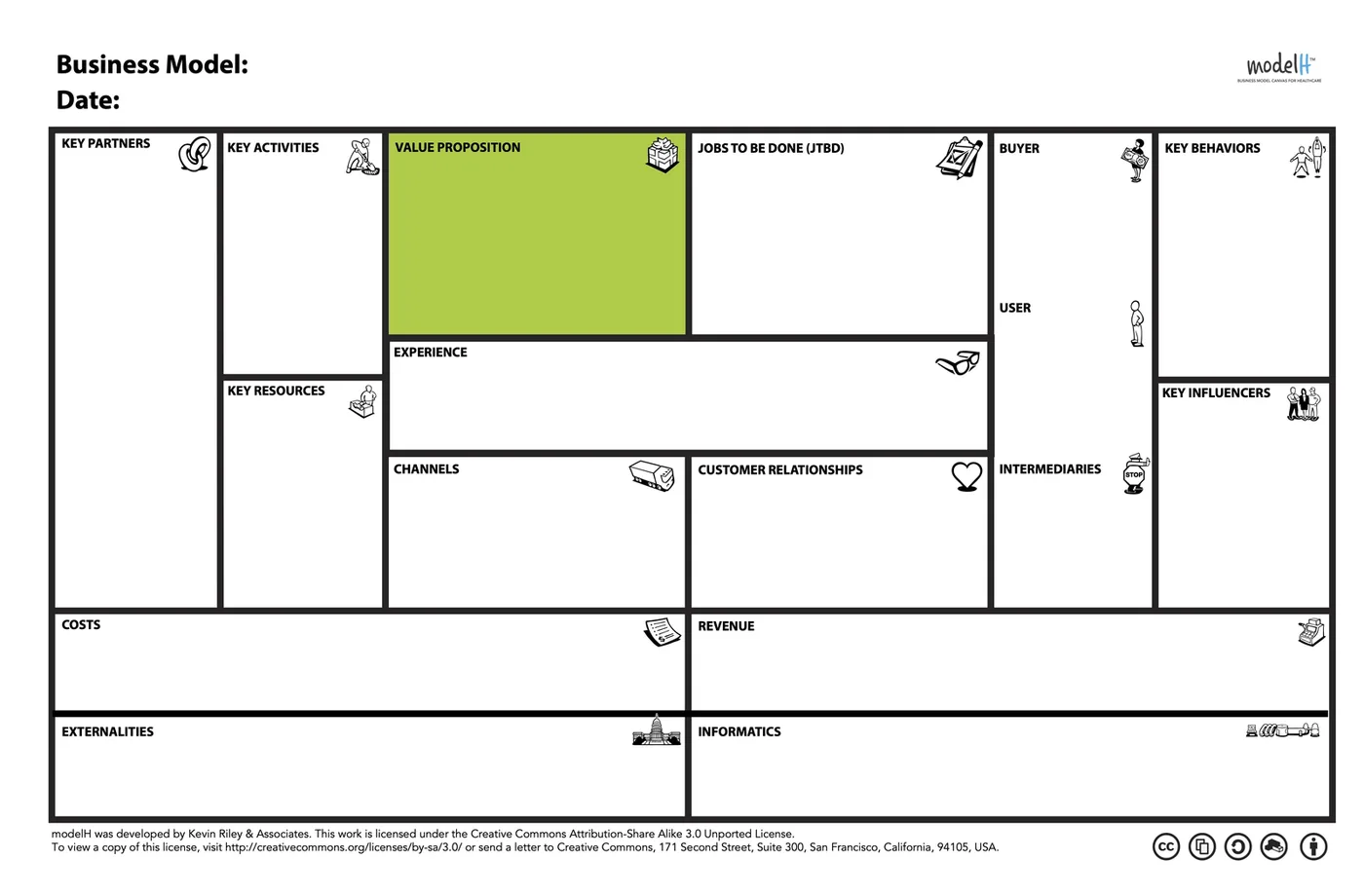
modelH Business Model Placemat: Value Proposition
A Value Proposition is the promise at the center of your business model. Over the last four posts, we defined it, canvased it, tested it with an MVP, and asked when to pivot it. If you remember only four things, make them these.
1st: Establish a Value Proposition That Fits
Reach a point where a defined Customer Segment will hire your product for a defined JTBD. Until you have Product-Market Fit, everything else is a guess. Scaling a poor fit only makes you fail faster and more expensively.
2nd: Increase Your Value
Commit to Customer Intimacy. Occupy a place in your customers' lives so that you learn from them continually. Value is Michael Porter's outcomes per dollar, so keep asking whether outcomes are rising or cost is falling.
3rd: Develop Your Unique Advantage
Identify the one thing you do that others cannot easily match, and defend it. Use Porter's generic strategies to decide: cost leadership, differentiation, or focus. Trying to be all three usually means being none of them.
4th: Pivot When the Evidence Says So
Use levers for small adjustments and pivots for changes of direction. Set your decision points before you launch. Otherwise, sunk costs and pride will make the decision for you.
A One-Minute Test
- Who, specifically, hires us?
- For which job?
- What is better, by how much, and compared with what?
- How do we know?
- What would make us change our minds?
What is Next?
To finish the What, we cover Experience, Channels, and Customer Relationships in six posts: Experience, Journey Mapping and its tools, Channels, Channel Threading, Customer Relationships, and a wrap-up.
to your health,
Kevin